
Does Low-E Glass Really Work—and Is It Worth the Cost?
Does Low-E glass really work? See our Clear vs. Cardinal Low-E test and learn the pros, cons, and whether upgrading your window glass is worth it.
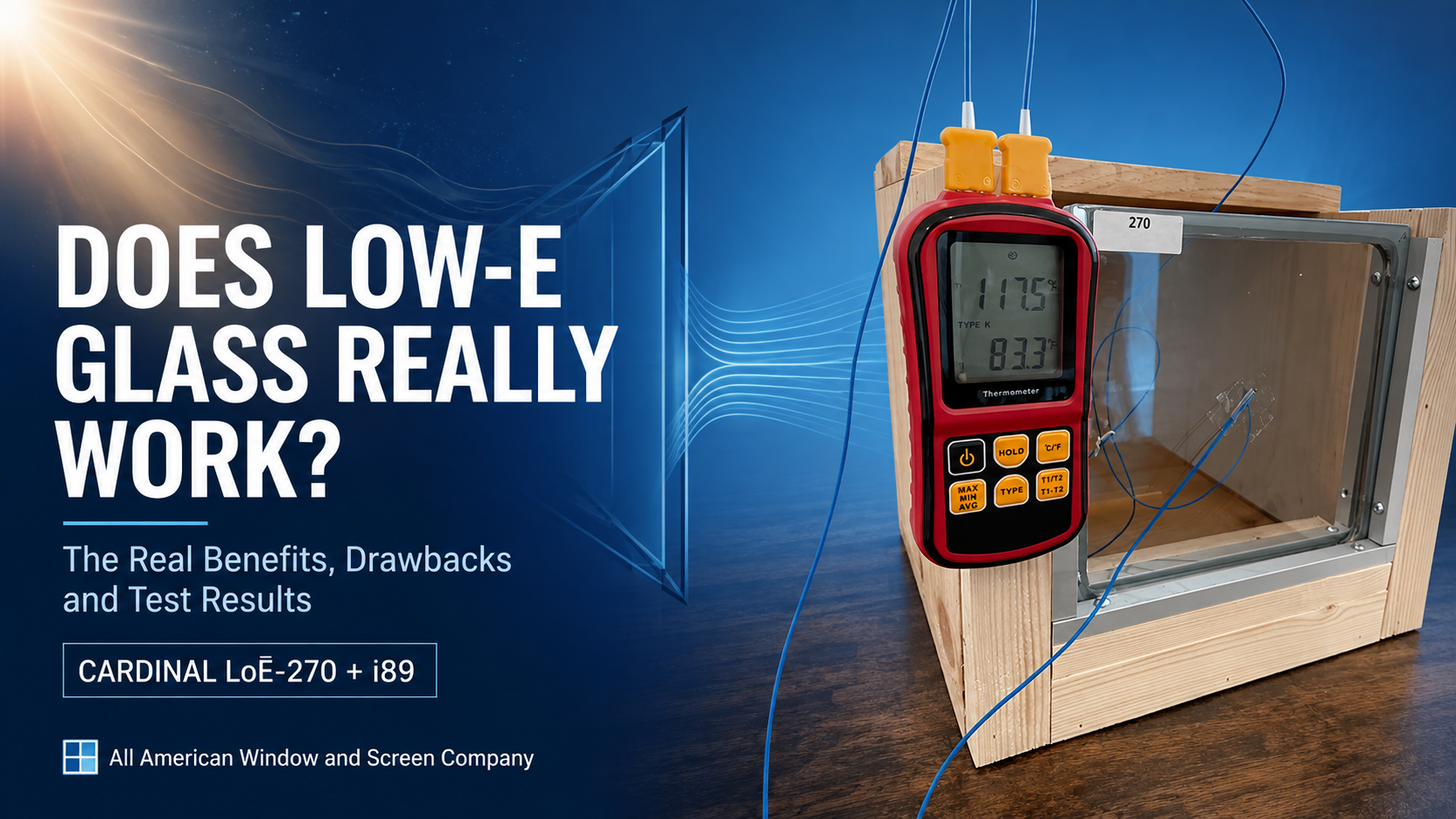
If you have ever stood beside a sunny window and felt heat pouring through the glass, you already understand the problem Low-E glass is designed to address. But does Low-E glass actually make a measurable difference, or is it simply another expensive upgrade?
The short answer is yes—Low-E glass works. However, not every Low-E coating performs the same, and the most expensive or darkest option is not automatically right for every home.
To see the difference ourselves, All American Window and Screen Company conducted a controlled demonstration comparing standard Clear over Clear insulated glass with two Cardinal Low-E glass configurations.
What Is Low-E Glass?
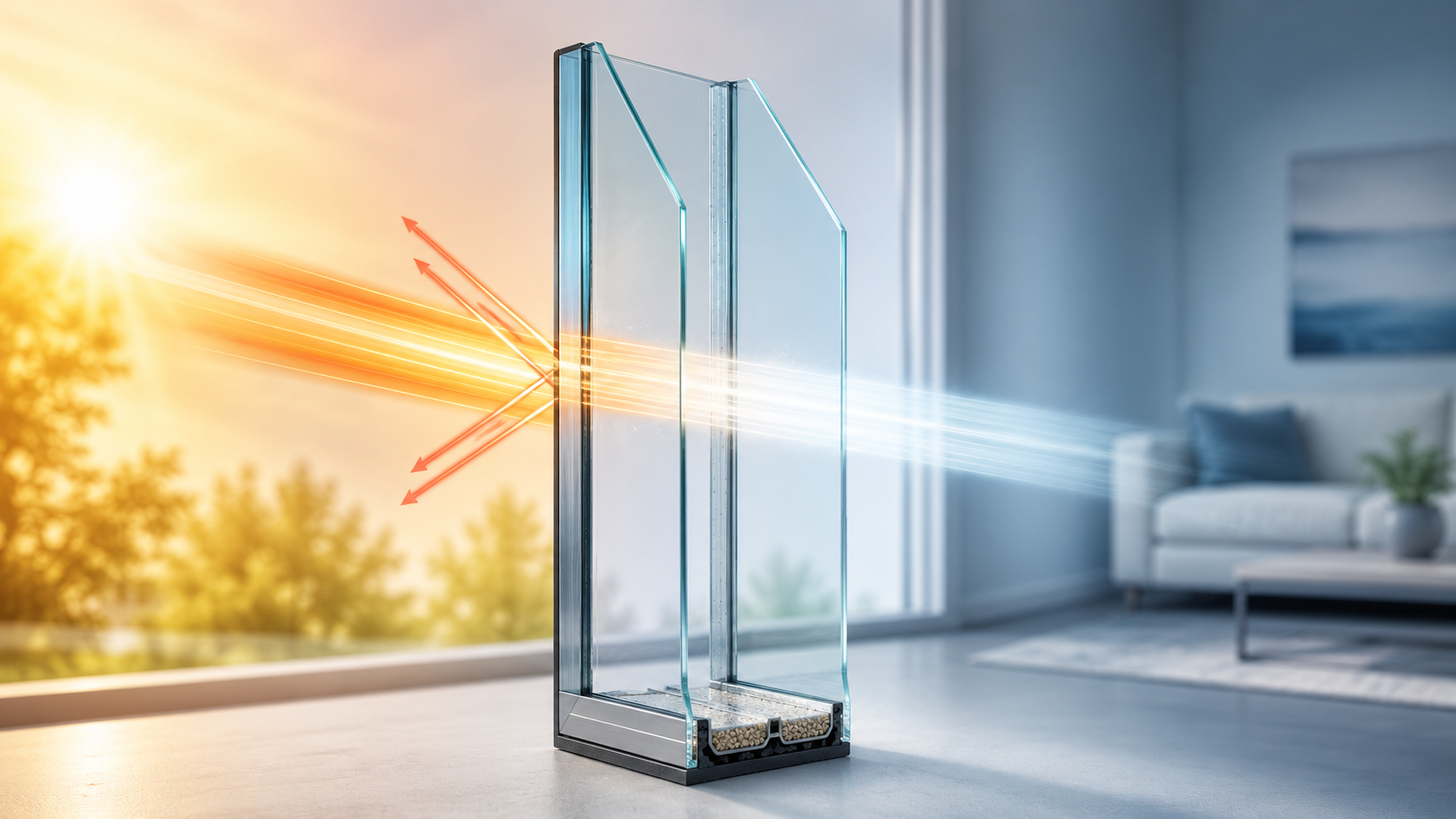
Low-E stands for “low emissivity.” Low-E glass has an extremely thin metallic coating that controls how radiant heat moves through the glass.
The coating is designed to reduce heat transfer while still allowing visible light through the window. In a hot climate such as North Texas, properly selected Low-E glass can reduce the amount of solar heat entering a home. During colder weather, it can also help reduce radiant heat loss through the glass.
According to the U.S. Department of Energy, Low-E coatings can lower a window’s U-factor and control solar heat gain and visible-light transmission.
Two important glass-performance measurements are:
U-factor: Measures the rate at which heat passes through the glass. A lower number indicates better insulating performance.
Solar Heat Gain Coefficient, or SHGC: Measures how much solar heat passes through the glass. A lower number means less solar heat enters the home.
In cooling-dominated climates, the Department of Energy recommends glass with a lower SHGC to reduce unwanted summer heat gain.
Our Clear Glass Versus Low-E Glass Demonstration
We exposed each insulated glass unit to the same general test conditions:
500-watt halogen lamp
Lamp positioned 16 inches from the glass
Five minutes of exposure
Surface temperatures measured on the exterior and interior panes
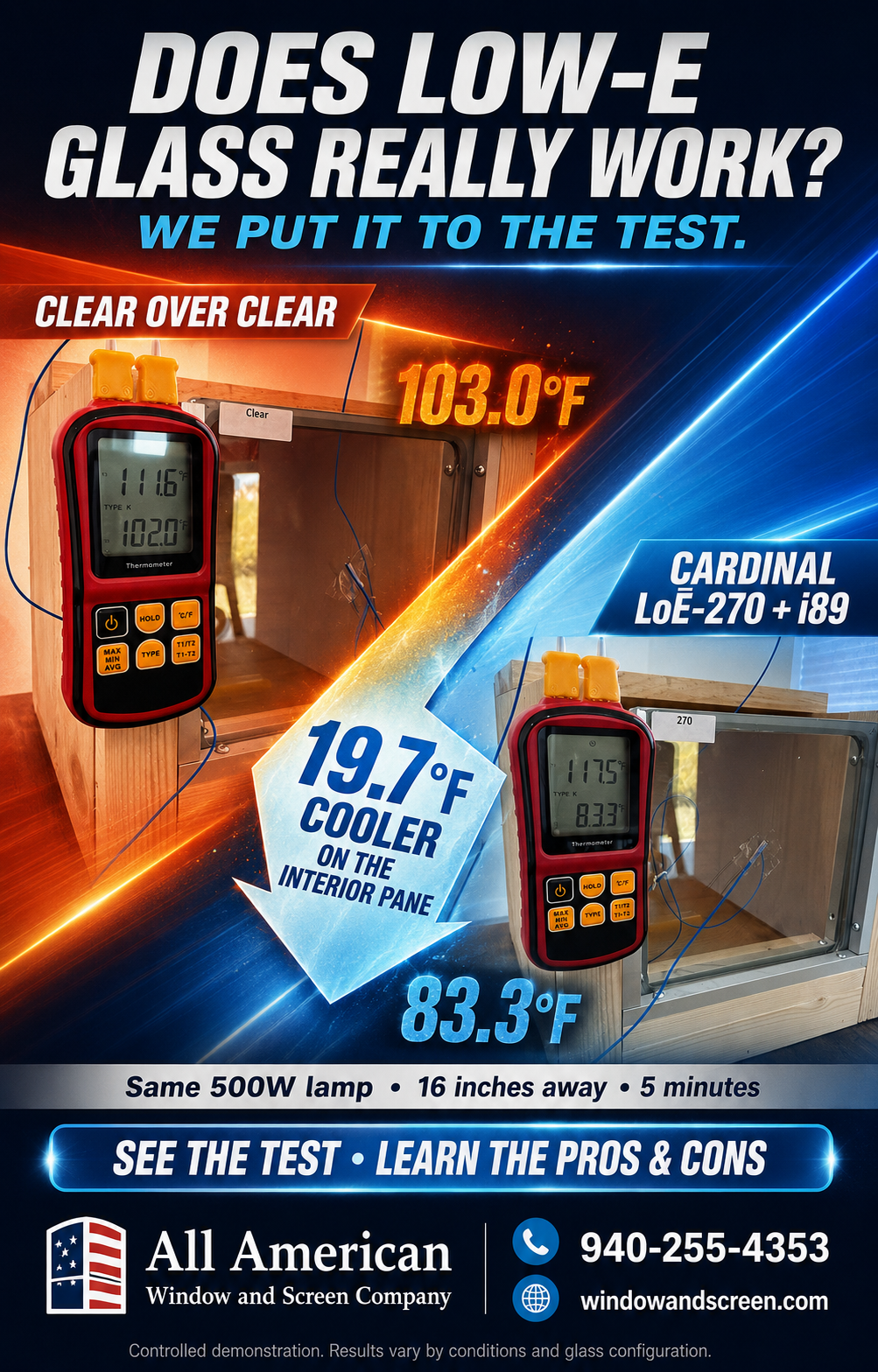
Here were the results:
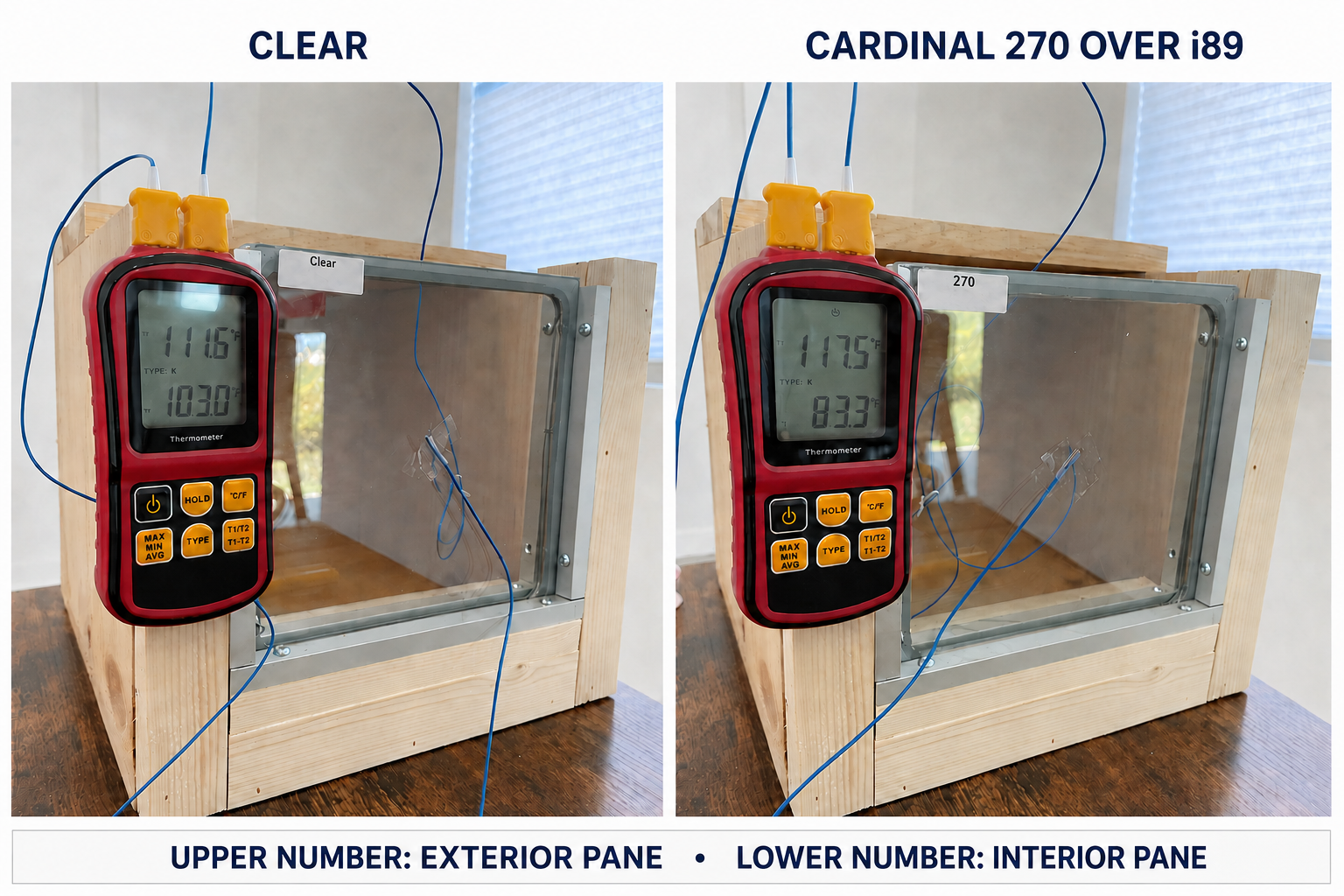
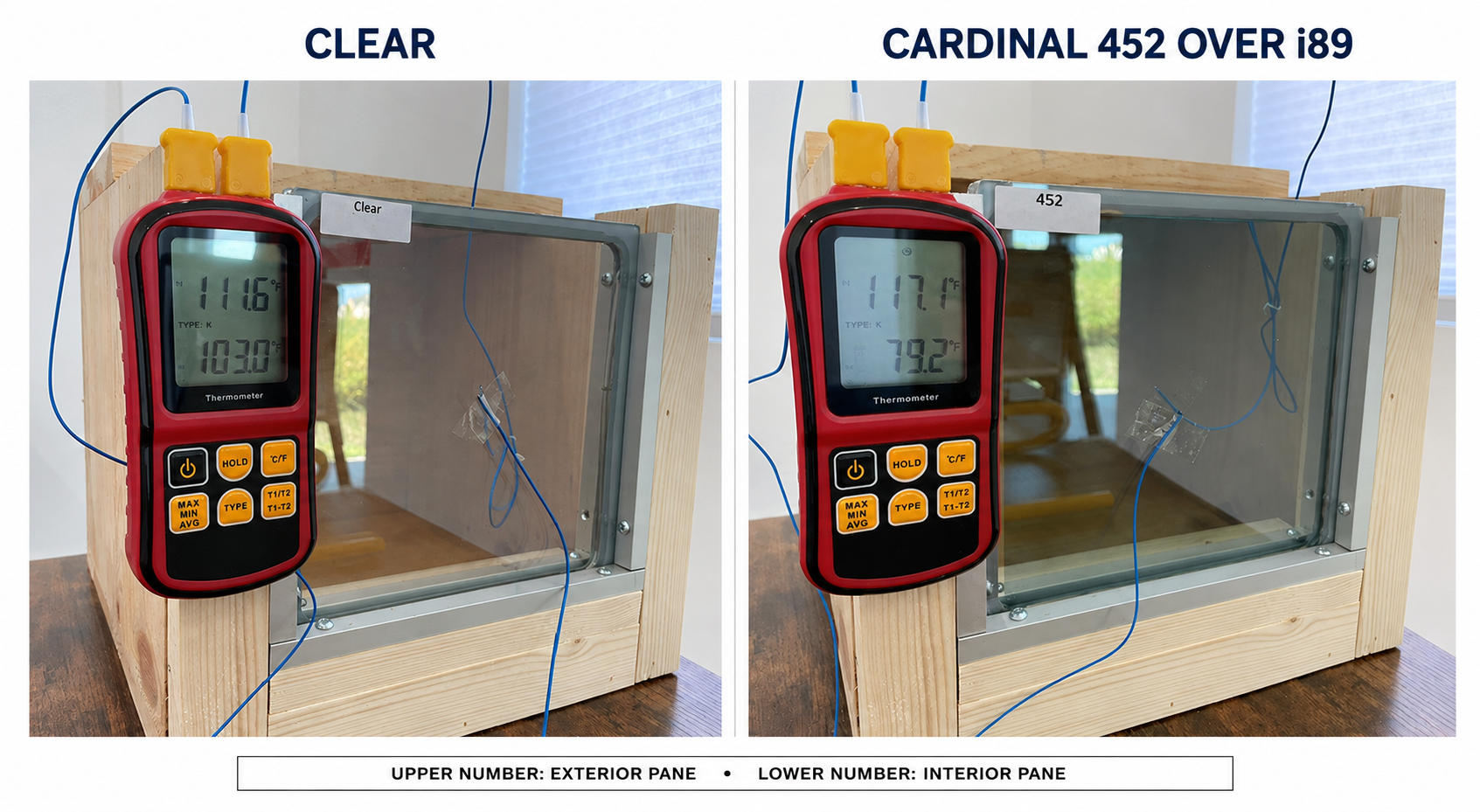
Clear over Clear glass
Exterior pane: 111.6°F
Interior pane: 103.0°F
Cardinal LoĒ-270 over i89
Exterior pane: 117.5°F
Interior pane: 83.3°F
Interior pane was 19.7°F cooler than Clear over Clear
Cardinal Quad LoĒ-452+ over i89
Exterior pane: 117.1°F
Interior pane: 79.2°F
Interior pane was 23.8°F cooler than Clear over Clear
The most important number is the temperature of the interior pane—the surface facing the inside of the home.
Although the exterior panes of the Cardinal units became hotter, considerably less heat reached the interior panes. A warmer exterior pane does not mean that the glass failed. In this demonstration, it was consistent with more of the lamp’s energy remaining on the exterior side instead of reaching the room-facing pane.
What Does the Test Actually Prove?
The test clearly demonstrates that the three glass configurations handled the lamp’s radiant energy differently. Under these controlled conditions, both Cardinal Low-E configurations kept their interior panes substantially cooler than Clear over Clear glass.
However, this was a practical demonstration—not a laboratory-certified NFRC test.
A halogen lamp does not perfectly reproduce the complete spectrum, angle or intensity of natural sunlight. Actual performance can also be affected by:
Outdoor temperature
Window direction and sun exposure
Shade from trees or roof overhangs
Glass size and airspace
Frame construction
Air leakage
Interior temperature and humidity
Installation quality
Condition of the home’s insulation and HVAC system
Therefore, this demonstration should not be used to promise an exact reduction in electric bills. It shows that Low-E glass can substantially reduce heat transfer through the glass under the tested conditions—not precisely how much money every homeowner will save.
The Pros of Low-E Glass

1. Reduced solar heat gain
This is one of the most valuable benefits in North Texas. A lower-SHGC glass configuration allows less solar heat to enter the home.
Cardinal classifies LoĒ-270 as a medium-solar-gain coating and Quad LoĒ-452+ as a low-solar-gain coating. For a standard ¾-inch, two-pane insulating glass unit, Cardinal reports an SHGC of approximately 0.37 for LoĒ-270 and 0.22 for Quad LoĒ-452+. Adding i89 can slightly reduce the SHGC further. Cardinal Glass performance information
The lower SHGC of the 452 configuration makes it especially useful for windows receiving intense Texas sun.
2. Cooler interior glass surfaces
Our demonstration showed interior-pane differences of 19.7°F with Cardinal LoĒ-270 over i89 and 23.8°F with Cardinal Quad LoĒ-452+ over i89.
Cooler room-side glass may reduce the uncomfortable radiant heat people feel while sitting or standing near sun-exposed windows.
3. Improved comfort in hot rooms
Low-E glass can help reduce hot spots in rooms with large windows or strong afternoon exposure. West-facing windows are often especially troublesome because they receive intense late-day sunlight when outdoor temperatures are already high.
Low-E glass will not correct every comfort problem, but it can address heat entering directly through the glass.
4. Reduced cooling demand
By reducing unwanted heat gain, Low-E glass can reduce part of the cooling load placed on the air-conditioning system.
That does not mean every homeowner will receive the same electric-bill savings. Savings depend on the amount of glass, window direction, climate, thermostat settings, HVAC efficiency, insulation and many other factors.
5. Better cold-weather performance
Low-E coatings also help slow radiant heat loss through the glass during colder weather. A lower U-factor means less heat flows through the glazing system.
The i89 room-side coating is specifically designed to improve thermal performance and help maintain a warmer interior glass surface during heating conditions. Cardinal states that this can also help reduce the occurrence of interior condensation. Cardinal LoĒ-i89 information
6. Better protection against fading
Low-E glass can reduce ultraviolet transmission and other portions of solar energy associated with fading.
This may help protect:
Flooring
Furniture
Curtains
Artwork
Photographs
Interior finishes
No residential glass completely eliminates fading, but selecting glass with lower fade transmission can slow the process.
7. Natural light without accepting as much heat
Low-E coatings are designed to reduce heat transfer while preserving useful daylight. This can provide an advantage over dark shades or other solutions that reduce heat only by blocking the view and natural light.
However, different Low-E coatings transmit different amounts of visible light. That tradeoff must be considered when selecting the glass.
8. The entire window may not need replacement
If the existing frames, sashes and operating components remain in good condition, it may be possible to replace only the insulated glass unit.
This can allow a homeowner to upgrade from clear glass to Low-E glass without removing the complete window frame. It can be especially practical when an existing insulated-glass seal has already failed and the glass needs replacement anyway.
The Cons of Low-E Glass
1. Higher initial cost
Low-E insulated glass costs more than basic Clear over Clear glass. The exact difference depends on the coating, glass size, tempering requirements, shape and configuration.
The upgrade is easier to justify when the existing glass is already broken, foggy or experiencing seal failure. Replacing perfectly functional glass solely to reduce energy use requires a more careful cost-versus-benefit calculation.
2. It will not solve every energy-efficiency problem
Low-E glass addresses heat transfer through the glass, but it cannot repair:
Air leaking around the window
Damaged weatherstripping
Poorly insulated frames
Gaps around the window opening
Inadequate attic or wall insulation
An inefficient or improperly sized HVAC system
Ductwork leaks
Installing high-performance glass in a severely deteriorated or air-leaking window frame may produce disappointing results.
3. More heat control can mean less visible light
Stronger solar-control coatings generally allow less visible light through the glass.
Cardinal reports approximately 70% visible-light transmission for LoĒ-270 and approximately 52% for Quad LoĒ-452+ in the listed ¾-inch, two-pane configurations. The final appearance can vary based on glass thickness, coating placement, added i89, surroundings and lighting conditions.
Cardinal’s Low-E color simulator also shows that different coatings can change the interior and exterior appearance of the glass.
Homeowners who want maximum natural light may prefer LoĒ-270. Homeowners who prioritize stronger solar control may prefer Quad LoĒ-452+.
4. Glass color and reflectivity may be noticeable
Some Low-E products have a slight tint or increased reflectivity. The difference may be subtle from inside but more noticeable from the exterior, particularly when Low-E glass is installed next to older clear glass.
Replacing only one or two units on a highly visible elevation may create an appearance mismatch. The new glass should be compared with the surrounding windows before ordering.
5. The strongest solar-control glass is not right everywhere
A very low SHGC is useful in hot climates and on heavily sun-exposed windows, but it also reduces beneficial winter solar gain.
A north-facing window protected by shade may not require the same solar-control coating as a large west-facing window receiving intense afternoon sun. Using the same glass everywhere without considering orientation can be a lazy—and sometimes wasteful—approach.
6. Glass-only replacement does not improve the frame
Replacing the insulated glass can improve the performance of the glass area, but it does not change the efficiency of the existing frame.
Published center-of-glass performance numbers should not be confused with the certified performance of an entire window. The frame, sash, spacer, size and hardware all influence whole-window performance.
7. Low-E glass is not damage-proof
Low-E coatings improve thermal performance, but they do not make the glass unbreakable. The insulated unit can still be damaged by impact, improper installation, building movement or eventual seal failure.
Cardinal LoĒ-270 Over i89 or Quad LoĒ-452+ Over i89?
Neither product is automatically best for every homeowner.
Cardinal LoĒ-270 over i89 may be a better choice when:
You want improved efficiency without substantially darkening the view
Natural light is a major priority
The windows receive moderate sun exposure
You want balanced year-round performance
You prefer a more neutral appearance
Cardinal Quad LoĒ-452+ over i89 may be a better choice when:
Reducing Texas solar heat is the main priority
The windows face west or receive intense afternoon sun
The room has large areas of glass
The room consistently becomes hotter than the rest of the home
Additional UV and fade protection is important
You are comfortable with somewhat lower visible-light transmission
Is Low-E Glass Worth It?

Low-E glass is usually worth considering when:
Existing insulated glass is foggy, broken or experiencing seal failure
The room becomes noticeably hotter because of sun exposure
Furniture or flooring is fading near the windows
You feel radiant heat while sitting near the glass
The frames remain in good condition
You plan to stay in the home long enough to benefit from improved comfort and possible energy savings
It may not be the best investment when:
The frames are badly damaged or leaking air
The installation around the window has failed
The windows receive very little direct sunlight
The home has larger insulation or HVAC problems that should be corrected first
The glass is still functional and the replacement cost cannot reasonably be recovered through comfort, protection or energy benefits
The Bottom Line

For most North Texas homeowners, Low-E glass is worth the additional cost—especially when the existing insulated glass is already broken, foggy or experiencing seal failure and needs to be replaced anyway. In that situation, the homeowner is already paying for new glass, so the decision is whether to reinstall basic clear glass or spend somewhat more for better heat control, improved comfort and additional protection against fading.
The upgrade can also make sense for west- and south-facing windows, rooms that become noticeably hotter during the afternoon, large areas of glass, or windows near furniture and flooring that receive substantial sunlight.
Replacing perfectly functional clear glass throughout an entire home is a more complicated decision. Low-E glass may improve comfort and reduce part of the home’s cooling load, but the energy savings alone may take years to recover the replacement cost. It also cannot correct air leaks, damaged frames, poor insulation or an inefficient HVAC system.
Low-E glass is not a gimmick. The technology is well established, and both Department of Energy guidance and published manufacturer performance data show that Low-E coatings can reduce heat transfer and solar heat gain.
Our demonstration produced a clear difference: compared with the 103.0°F interior pane of the Clear over Clear unit, Cardinal LoĒ-270 over i89 measured 83.3°F and Cardinal Quad LoĒ-452+ over i89 measured 79.2°F after the same five-minute exposure.
That does not guarantee a specific reduction in anyone’s electric bill, but it provides a convincing demonstration that glass selection matters.
If your existing window frames are still in good condition, upgrading the insulated glass may be a practical alternative to replacing the entire window.
Call or text All American Window and Screen Company at 940-255-4353 for a free estimate.
Visit windowandscreen.com.
Serving Justin, Northlake, Argyle, Flower Mound, Bartonville, Lantana, Haslet, Keller, Roanoke, Trophy Club, Grapevine, Lewisville, Denton, Decatur, Rhome, Bridgeport and Northwest Fort Worth.
Test results were obtained from a controlled demonstration using a 500-watt halogen lamp positioned 16 inches from the glass for five minutes. Results can vary based on environmental conditions, glass configuration, window construction and installation.
What Happens When You Leave Failed Window Seals Unchecked?
Learn what happens when failed window seals go unchecked, from foggy glass and reduced efficiency to Low-E damage—and when glass replacement helps.
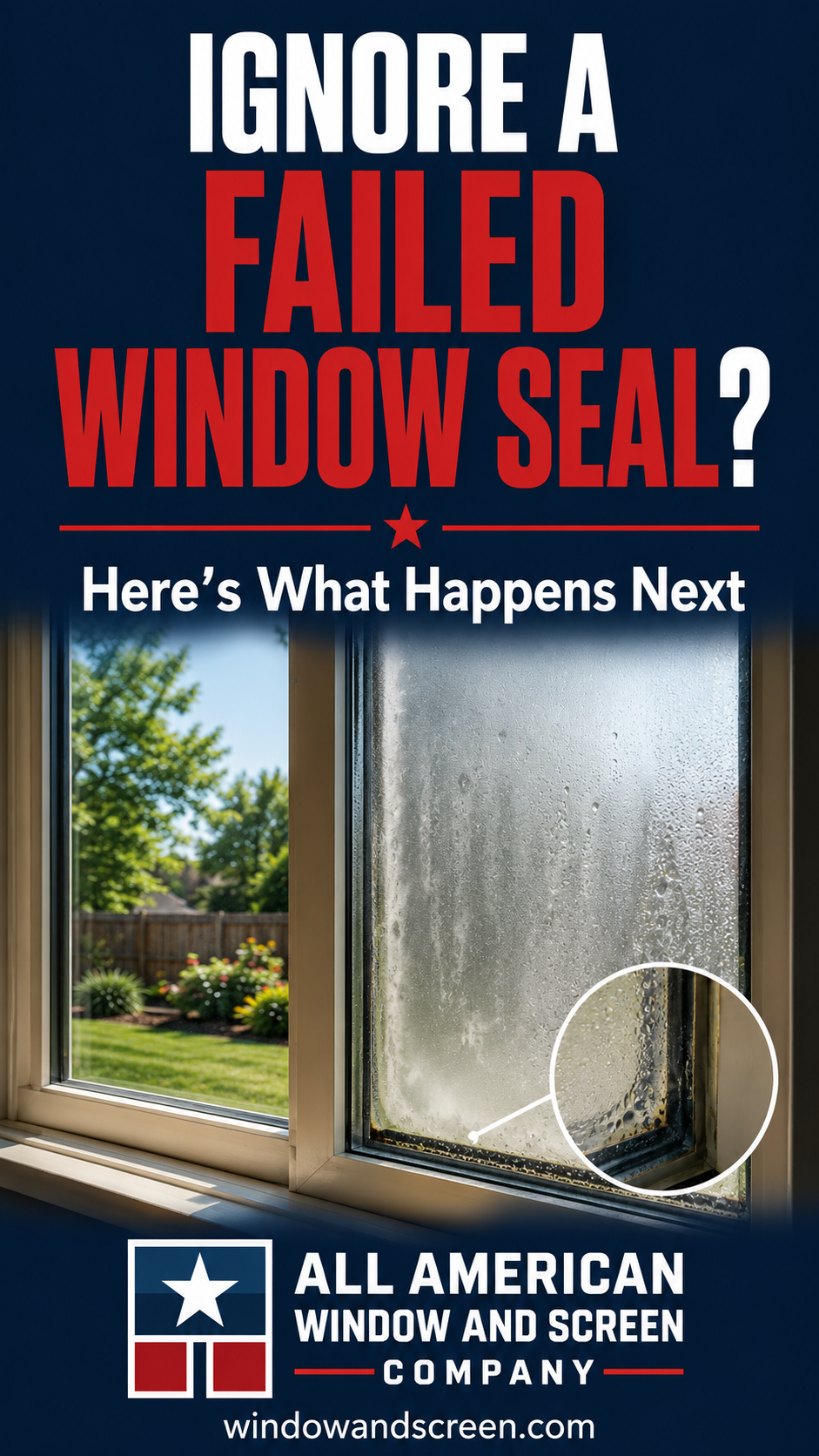
Foggy or cloudy glass is more than a cosmetic problem. When condensation appears between the panes of a double-pane window, it usually means the seal around the insulated glass unit has failed.
Once that seal fails, the window can no longer perform exactly as it was designed. The problem typically gets worse over time, and it cannot be corrected by cleaning either side of the window.
What Is a Failed Window Seal?
A double-pane insulated glass unit consists of two pieces of glass separated by a spacer and sealed around the perimeter. The sealed airspace helps reduce heat transfer through the glass.
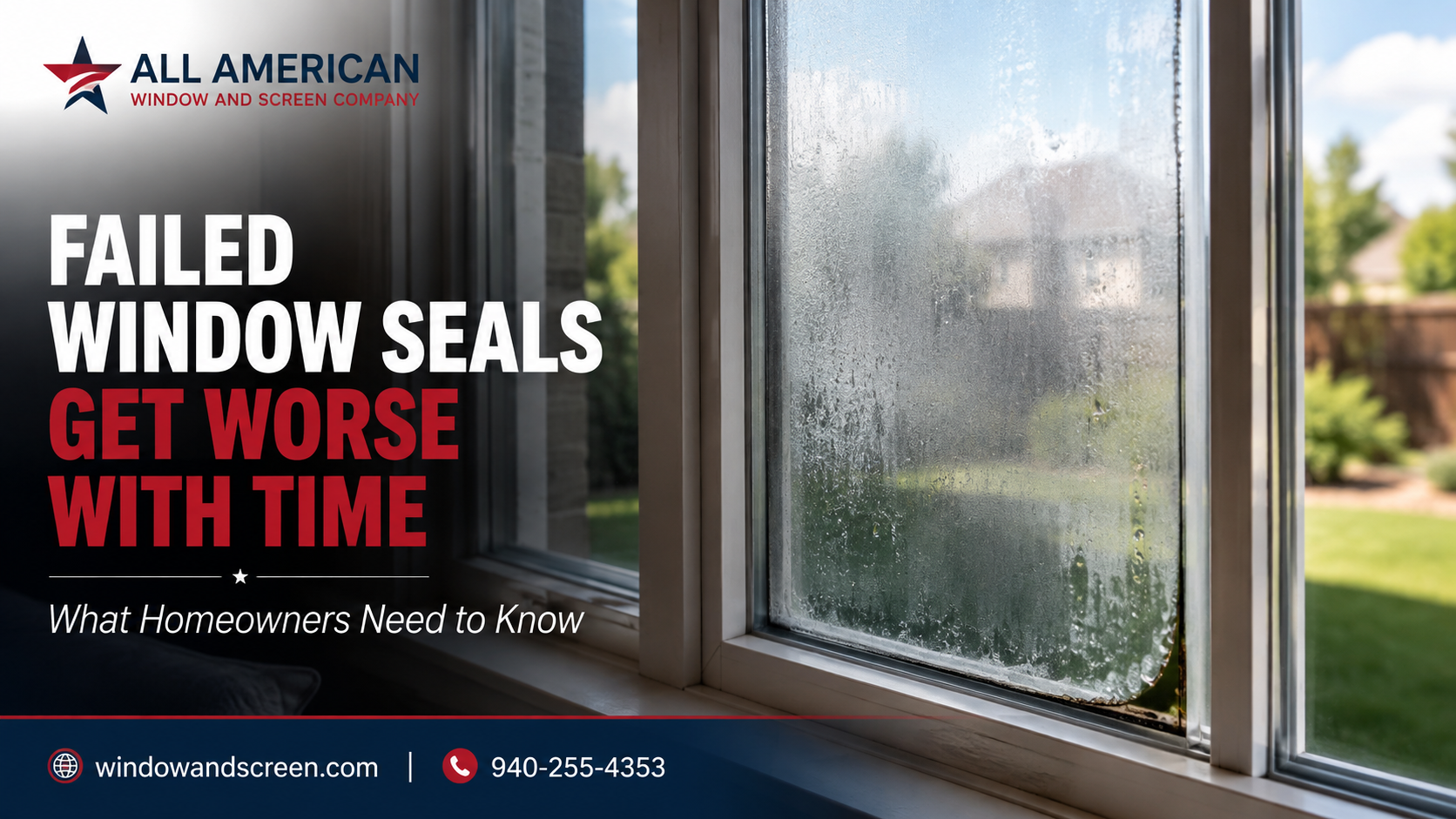
When the perimeter seal breaks down, outside air and moisture can enter that space. Depending on the temperature and humidity, you may notice:
Condensation between the panes
A cloudy or hazy appearance
Water droplets inside the glass unit
Mineral deposits or streaking
Discoloration or oxidation of a Low-E coating
The fog may initially appear only during certain weather conditions. However, once moisture is entering between the panes, the seal has already failed.
The View Will Usually Get Worse
A failed seal may begin as a small amount of condensation in one corner. Over time, moisture can spread across more of the glass.
As the moisture repeatedly evaporates and condenses, it can leave behind mineral deposits and permanent staining. Eventually, the glass may remain cloudy even when no visible condensation is present.
Because the moisture is trapped inside the insulated glass unit, homeowners cannot clean it from either side.
The Window’s Energy Performance May Decline
A failed seal can reduce the insulating performance of the glass unit. If the window was manufactured with insulating gas between the panes, that gas may gradually escape and be replaced by ordinary air containing moisture.
The actual amount of energy loss will vary based on the glass, window construction, climate, size of the failure and how long the seal has been compromised. One failed unit may not cause a dramatic increase in an electric bill by itself, but multiple failed units can contribute to uncomfortable temperatures and additional heating or cooling demand.
Low-E Coatings Can Become Damaged
Some insulated windows contain a Low-E coating inside the sealed airspace. This coating is protected from exposure as long as the unit remains properly sealed.
When moisture and oxygen enter the airspace, certain Low-E coatings can begin to oxidize. This may create a cloudy, blotchy, rainbow-like or metallic appearance.
Once a Low-E coating has oxidized, it cannot be restored through cleaning. The affected insulated glass unit must be replaced.
Rooms May Become Less Comfortable
A failed insulated glass unit may allow more heat to move through the window than intended. Depending on the season and the window’s exposure, homeowners may notice:
Warmer areas near the glass during the summer
Colder glass surfaces during the winter
More noticeable temperature differences throughout the room
Increased demand on the heating or air-conditioning system
The change may be subtle with one window, but it can become much more noticeable when several windows have failed.
Delaying Replacement Can Affect Your Home’s Appearance and Value
Foggy windows are highly visible from both inside and outside the home. They can make otherwise well-maintained windows look dirty, damaged or neglected.
This becomes especially important when selling a home. Buyers and home inspectors frequently notice condensation between window panes. What appears to be a small cosmetic issue can become a repair request, negotiation point or concern about the condition of the remaining windows.
Addressing failed glass before listing the property allows the homeowner to control the repair instead of negotiating under pressure.
A Failed Seal Does Not Automatically Mean You Need New Windows
This is where homeowners are often sold more than they need.
If the window frames are still in good condition, operate properly and are not leaking water into the home, the insulated glass unit can often be replaced without replacing the entire window.
Glass replacement allows the existing frame to remain in place while the failed double-pane glass is removed and replaced with a new sealed unit. This is frequently less disruptive and less expensive than a complete window replacement.
A full window replacement may make more sense when the frames are rotted, warped, damaged, poorly installed or no longer operating correctly. The condition of the entire window should be evaluated before making that decision.
Can a Failed Window Seal Be Repaired?
The original seal cannot simply be restored while leaving the existing glass unit intact. Services that drill holes or attempt to remove moisture may temporarily improve the appearance, but they do not recreate the original factory-sealed insulated glass unit.
The dependable solution is to replace the failed insulated glass unit.
Homeowners may choose replacement clear insulated glass or upgrade to an energy-efficient Low-E glass option. The best choice depends on the window’s location, sun exposure, desired appearance and energy-performance goals.
Do Not Ignore the Warning Signs
A failed window seal is not usually an emergency, and it does not automatically mean rainwater is leaking into your walls. However, it will not repair itself.
Waiting can lead to worsening condensation, permanent staining, damaged Low-E coatings, reduced performance and a more obvious problem when it is time to sell the home.
All American Window and Screen Company replaces failed insulated window glass while preserving the existing window frames whenever they are still in good condition. We can also discuss clear glass and energy-efficient Low-E options based on the needs of your home.
Call or text 940-255-4353 or visit windowandscreen.com to request an evaluation.
Serving Justin, Flower Mound, Argyle, Northlake, Bartonville, Lantana, Haslet, Keller, Roanoke, Trophy Club, Grapevine, Denton, Decatur, Rhome, Bridgeport and surrounding North Texas communities.
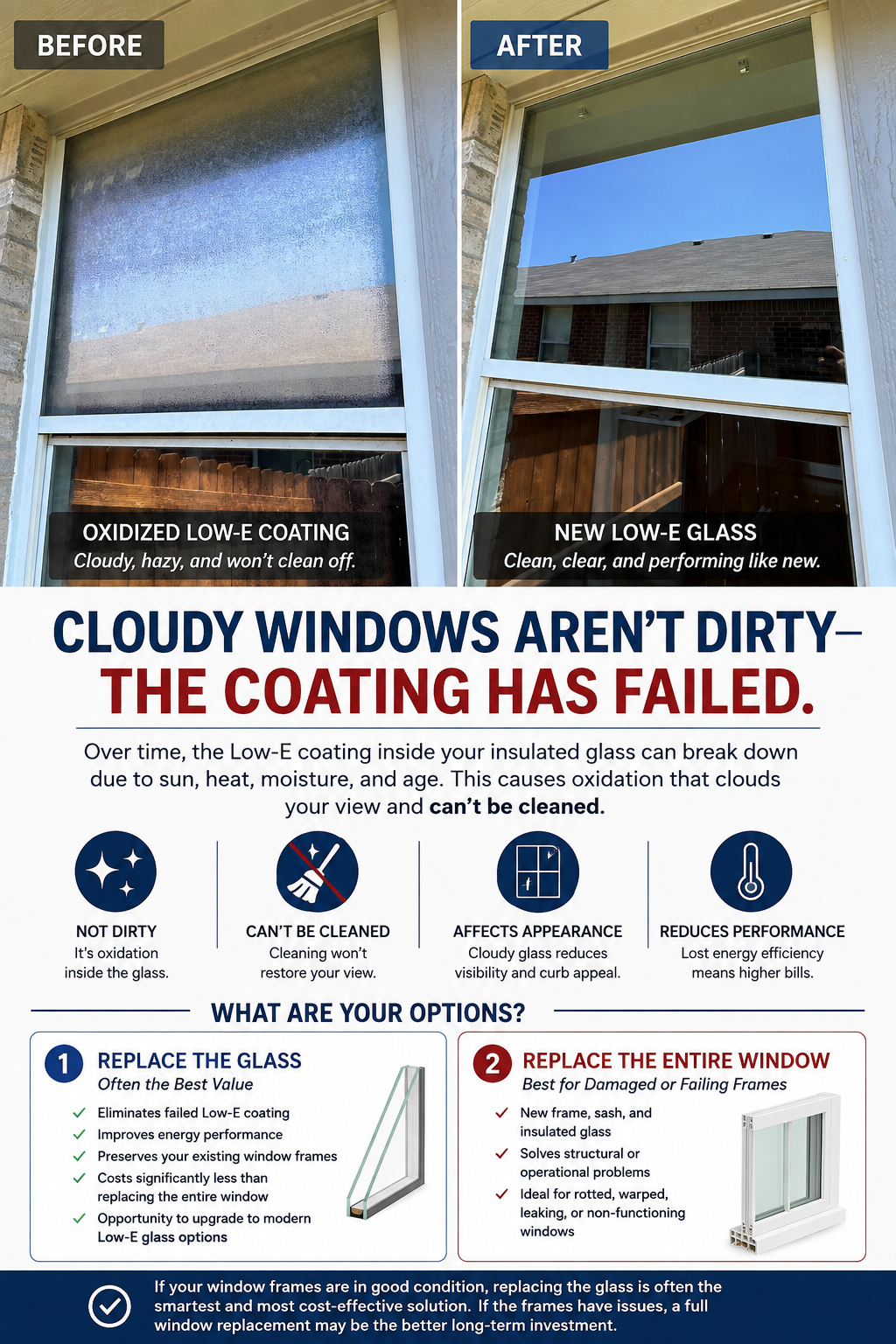
Oxidized Low-E Glass: Why Your Window Looks Cloudy and Why It Can't Be Cleaned
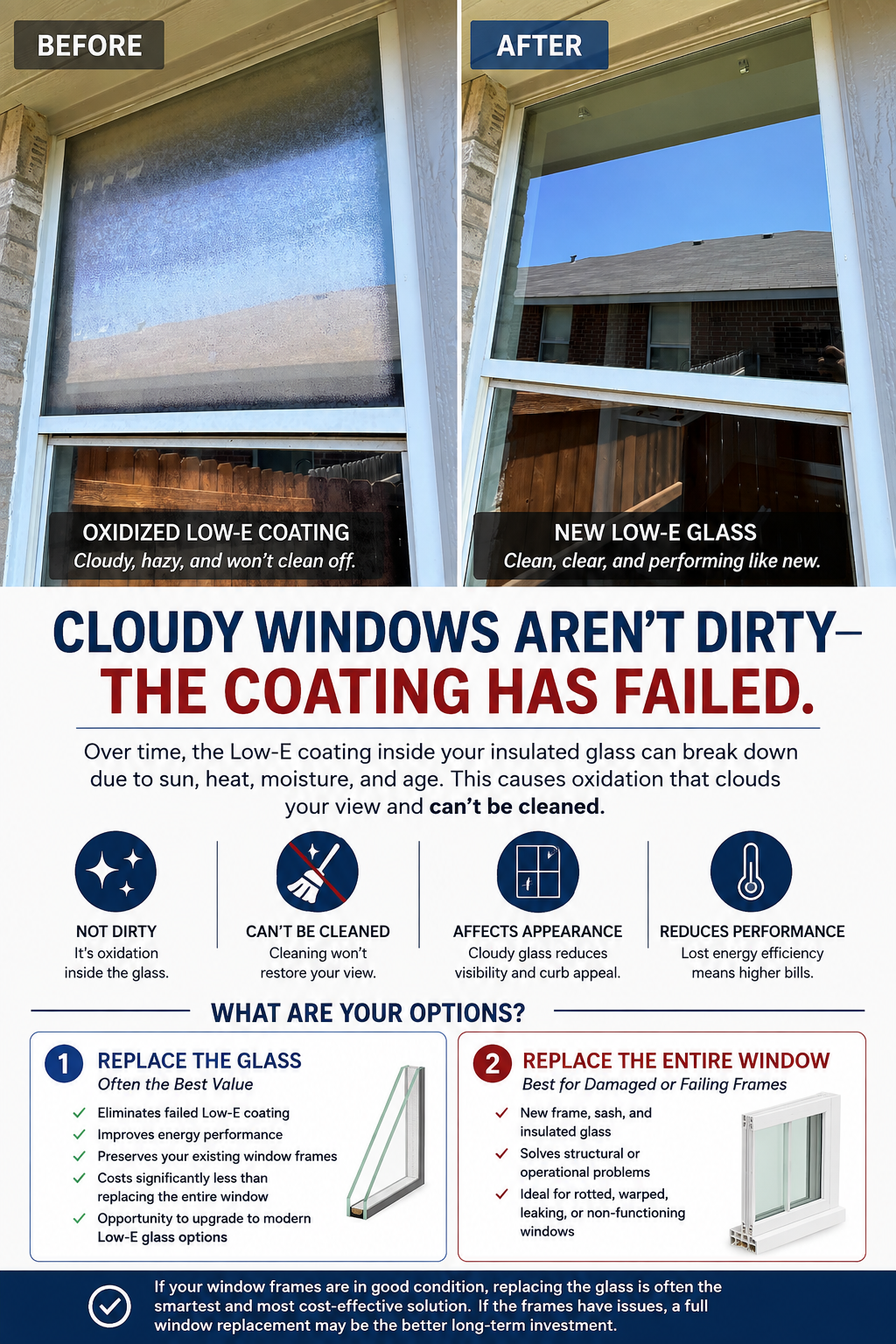
If you've cleaned your windows inside and out but still notice a cloudy, hazy, or speckled appearance, the problem may not be dirt at all.
In many cases, you're looking at oxidation of the Low-E coating inside the insulated glass unit. Unfortunately, this type of damage is permanent and cannot be cleaned away.
What Is Low-E Glass?
Low-E (Low Emissivity) glass is manufactured with a microscopically thin metallic coating that helps improve energy efficiency by reducing heat transfer and blocking a significant amount of harmful UV rays.
Most modern double-pane windows use Low-E glass because it helps keep homes more comfortable while reducing the workload on heating and cooling systems.
What Causes Low-E Oxidation?
Over time, exposure to heat, sunlight, moisture, and years of temperature changes can cause certain soft-coat Low-E coatings to deteriorate.
As the coating breaks down, it can develop a cloudy, blotchy, or speckled appearance that permanently affects the look of the glass. This deterioration occurs within the insulated glass unit and is not something on the surface that can simply be wiped away.
Although every window is different, oxidation is generally seen in older insulated glass units after many years of service.
Can It Be Cleaned?
No.
Because the damage is part of the glass assembly itself, window cleaners, razor blades, polishing compounds, or other cleaning methods will not remove it.
If your window still looks cloudy after cleaning both sides thoroughly, the insulated glass unit has likely reached the end of its service life.
What Are Your Options?
Replace the Glass (Often the Best Value)
If your window frames are still in good condition and operate properly, replacing only the insulated glass unit is often the most economical solution.
Benefits include:
Eliminates the oxidized or deteriorated Low-E coating
Restores the appearance of the window
Improves thermal performance with new insulated glass
Preserves your existing window frames
Typically costs significantly less than replacing the entire window
Provides the opportunity to upgrade to today's high-performance Low-E glass options
Replace the Entire Window
If the frame is damaged, rotted, warped, leaking, or no longer operates correctly, replacing the complete window may be the better long-term investment.
A full window replacement includes a new frame, sash, and insulated glass unit. While it is more expensive than replacing only the glass, it may be the right solution when the existing window has structural or operational issues.
Which Option Is Right for You?
The condition of the window frame is usually the deciding factor.
If the frame is structurally sound, replacing only the insulated glass can restore the window's appearance and improve its energy performance without the cost of a complete window replacement.
If the frame itself has reached the end of its life, replacing the entire window may provide the best long-term value.
An experienced glass professional can inspect your windows and recommend the solution that makes the most sense for your home.
Trust the Experts at All American Window and Screen Company
At All American Window and Screen Company, we specialize in replacing failed insulated glass, including oxidized Low-E glass, fogged windows, and broken double-pane glass.
Our goal is simple: recommend the solution that best fits your windows—not the most expensive one. If your frames are in good condition, replacing the glass may be all that's needed. If a complete window replacement is the better option, we'll explain why and help you make an informed decision.
We proudly serve homeowners throughout Justin, Northlake, Argyle, Flower Mound, Roanoke, Trophy Club, Keller, Haslet, Denton, Decatur, Rhome, Bridgeport, and surrounding North Texas communities.
Call or Text: 940-255-4353
Visit: windowandscreen.com
Whether your windows need new glass or complete replacement, we're here to help you choose the right solution for your home.
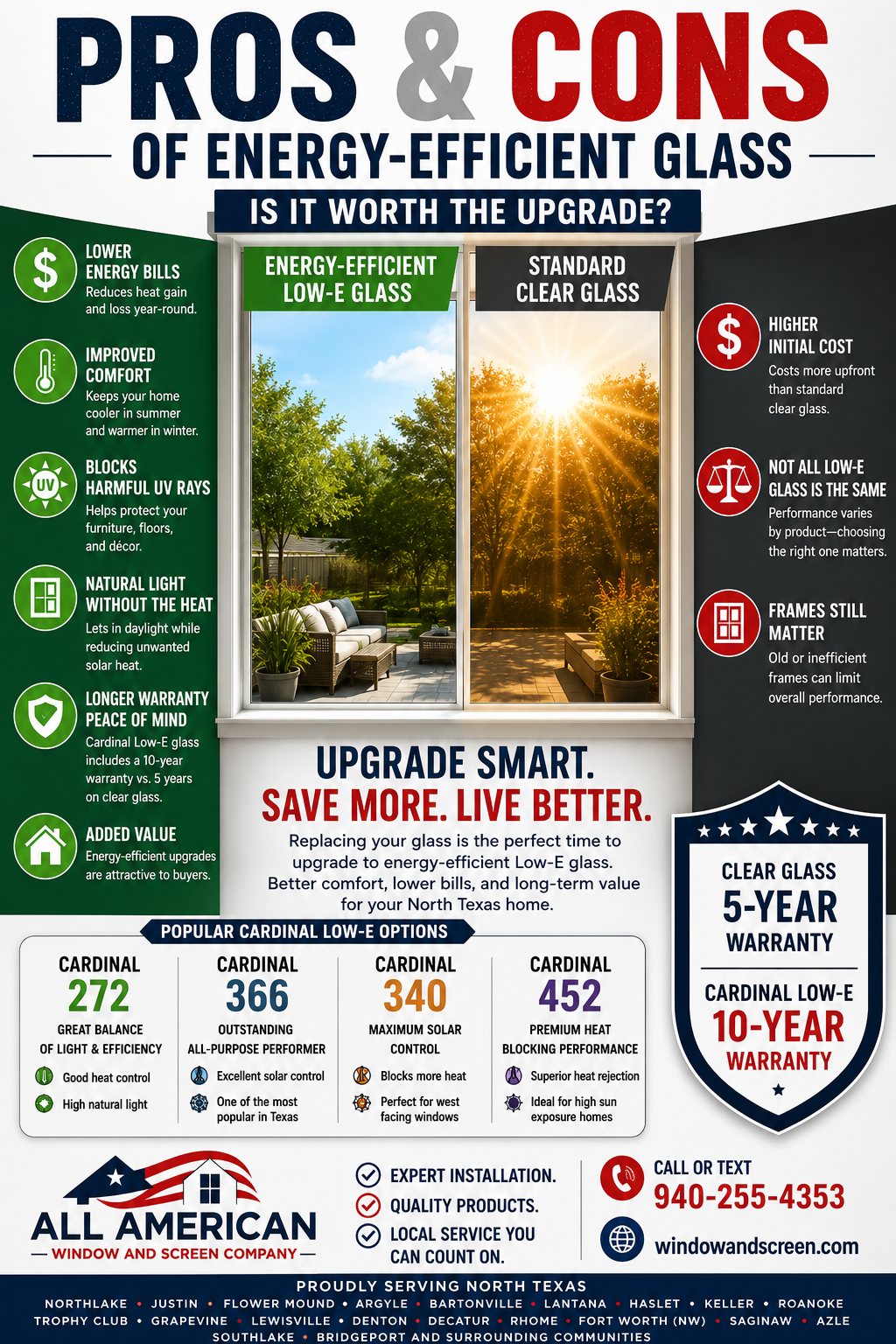
The Pros and Cons of Energy-Efficient Window Glass: Is It Worth the Upgrade?
Thinking about replacing foggy or broken window glass? Learn the pros and cons of energy-efficient Low-E glass, compare Cardinal Low-E options, and discover whether upgrading is worth the investment for your North Texas home.
When homeowners need to replace a broken or foggy insulated glass unit, one of the most common questions they ask is:
"Should I replace it with standard clear glass, or is energy-efficient Low-E glass worth the extra cost?"
The answer depends on your priorities, but for most North Texas homeowners, upgrading to energy-efficient glass is one of the best investments you can make—especially if the glass is already being replaced.
Let's look at the advantages and disadvantages so you can make an informed decision.
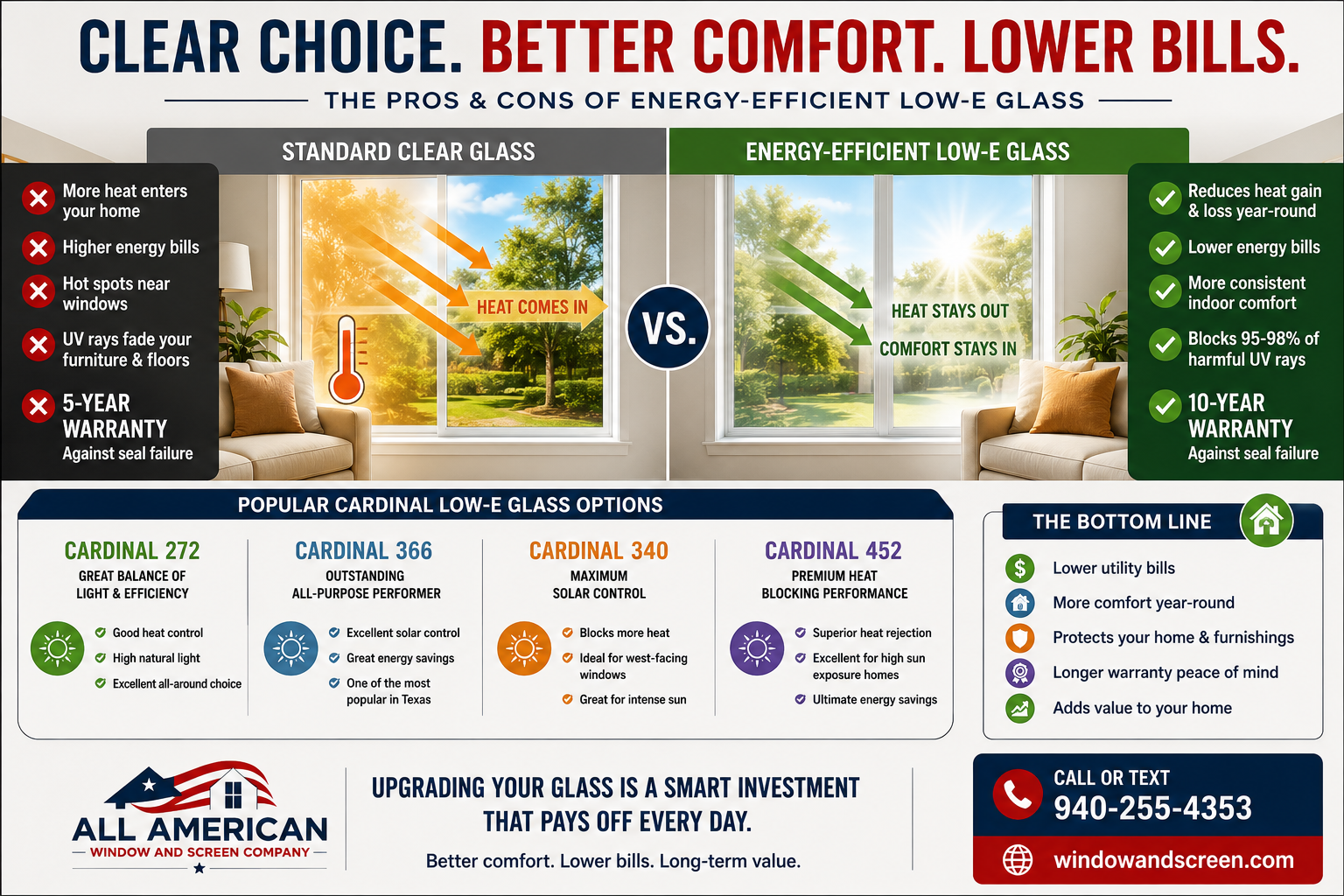
What Is Energy-Efficient Glass?
Energy-efficient glass, commonly called Low-E (Low Emissivity) glass, has a microscopically thin, virtually invisible coating that reflects heat while still allowing natural light to pass through.
Unlike ordinary clear glass, Low-E coatings are designed to help control how much heat enters and leaves your home.
The result?
Cooler homes during hot Texas summers
Improved comfort year-round
Lower energy usage
Better protection against UV damage
The Advantages of Energy-Efficient Glass
1. Lower Energy Bills
One of the biggest reasons homeowners choose Low-E glass is energy savings.
During the summer, ordinary clear glass allows a significant amount of the sun's heat into your home. Your air conditioner must work harder to remove that heat.
Low-E coatings reduce solar heat gain, helping your HVAC system run more efficiently.
Over time, those savings can offset much of the additional investment.
2. Improved Indoor Comfort
Have you ever noticed that rooms near large windows feel hotter than the rest of the house?
That's because sunlight creates hot spots inside the home.
Energy-efficient glass helps create more consistent indoor temperatures by reducing excessive heat entering through the glass.
Many homeowners immediately notice that rooms become more comfortable.
3. Blocks Harmful UV Rays
Ultraviolet (UV) rays don't just affect your skin.
They also fade:
Hardwood flooring
Furniture
Cabinets
Curtains
Area rugs
Artwork
Many Cardinal Low-E products block 95% to 98% of harmful UV rays, helping preserve your home's interior.
4. Maintains Natural Daylight
Many homeowners assume energy-efficient glass makes their home darker.
Modern Low-E glass is engineered to provide excellent visible light transmission while reducing unwanted heat.
Depending on the product selected, most homeowners notice very little difference in brightness.
5. Improved Home Value
Energy-efficient upgrades are attractive to buyers.
Although replacement glass alone won't dramatically increase a home's appraised value, buyers appreciate lower utility costs and upgraded windows.
6. Longer Manufacturer Warranty
This is one benefit many homeowners overlook.
At All American Window and Screen Company, our standard clear insulated glass units include a 5-year manufacturer's warranty against seal failure.
Many Cardinal Low-E insulated glass units include a 10-year manufacturer's warranty against seal failure.
That's double the warranty coverage!
7. Better Temperature Control All Year
Energy-efficient glass doesn't just help during summer.
It also reflects interior heat back into the home during cooler months, reducing heat loss through the windows.
That means better comfort year-round.
The Disadvantages of Energy-Efficient Glass
Like any home improvement product, Low-E glass isn't perfect.
Here are a few considerations.
1. Higher Initial Cost
Energy-efficient glass costs more than standard clear glass.
However, when replacing a failed insulated glass unit, the price difference is often much smaller than homeowners expect.
Because the labor is essentially the same, the upgrade is frequently one of the best values available.
2. Choosing the Right Low-E Product Matter
Not all Low-E glass performs the same.
For example:
Cardinal 272
Great balance of natural light and energy efficiency
Excellent all-around performer
Cardinal 366
Outstanding all-purpose performer
Excellent solar heat reduction
One of the most popular options in Texas
Cardinal 340
Maximum solar control
Ideal for west-facing windows with intense afternoon sun
Cardinal 452
Premium heat-blocking performance
Excellent choice for homes with significant solar exposure
Choosing the right product depends on your home's orientation, window location, and personal comfort preferences.
3. Existing Window Frames Still Matter
Replacing the glass dramatically improves performance, but the window frame also contributes to overall efficiency.
If your frames are in good condition, replacing only the insulated glass is often a very cost-effective upgrade.
Is It Worth Upgrading If Your Windows Are Already Foggy?
In many cases, yes.
If your insulated glass seal has already failed, you're already paying to replace the glass.
Upgrading to Low-E glass during that replacement often provides:
Better comfort
Better energy efficiency
UV protection
Longer warranty coverage
Improved resale appeal
For many homeowners, the additional investment is relatively small compared to the long-term benefits.
Which Cardinal Low-E Glass Is Right for You?
At All American Window and Screen Company, we offer several Cardinal Low-E options to match your home's needs.
Whether your goal is:
Maximum energy savings
More natural daylight
Reduced afternoon heat
Better UV protection
A balance of all of the above
We'll help you choose the right glass—not simply the most expensive one.
Final Thoughts
Energy-efficient glass isn't just about lowering utility bills.
It's about making your home more comfortable, protecting your furnishings, reducing strain on your HVAC system, and getting more value from your window investment.
If you're already replacing foggy or broken insulated glass, upgrading to a Cardinal Low-E product is often one of the smartest improvements you can make.
Ready to Upgrade Your Window Glass?
If you have foggy windows, broken glass, or simply want to improve your home's energy efficiency, we're here to help.
All American Window and Screen Company specializes in replacing insulated glass—not entire windows—saving homeowners thousands of dollars while delivering outstanding performance.
📞 Call or Text: 940-255-4353
🌐 Website:https://www.windowandscreen.com
Serving Northlake, Justin, Flower Mound, Argyle, Bartonville, Lantana, Haslet, Keller, Roanoke, Trophy Club, Grapevine, Lewisville, Denton, Decatur, Rhome, Northwest Fort Worth, Saginaw, Azle, Southlake, Bridgeport, and surrounding North Texas communities.
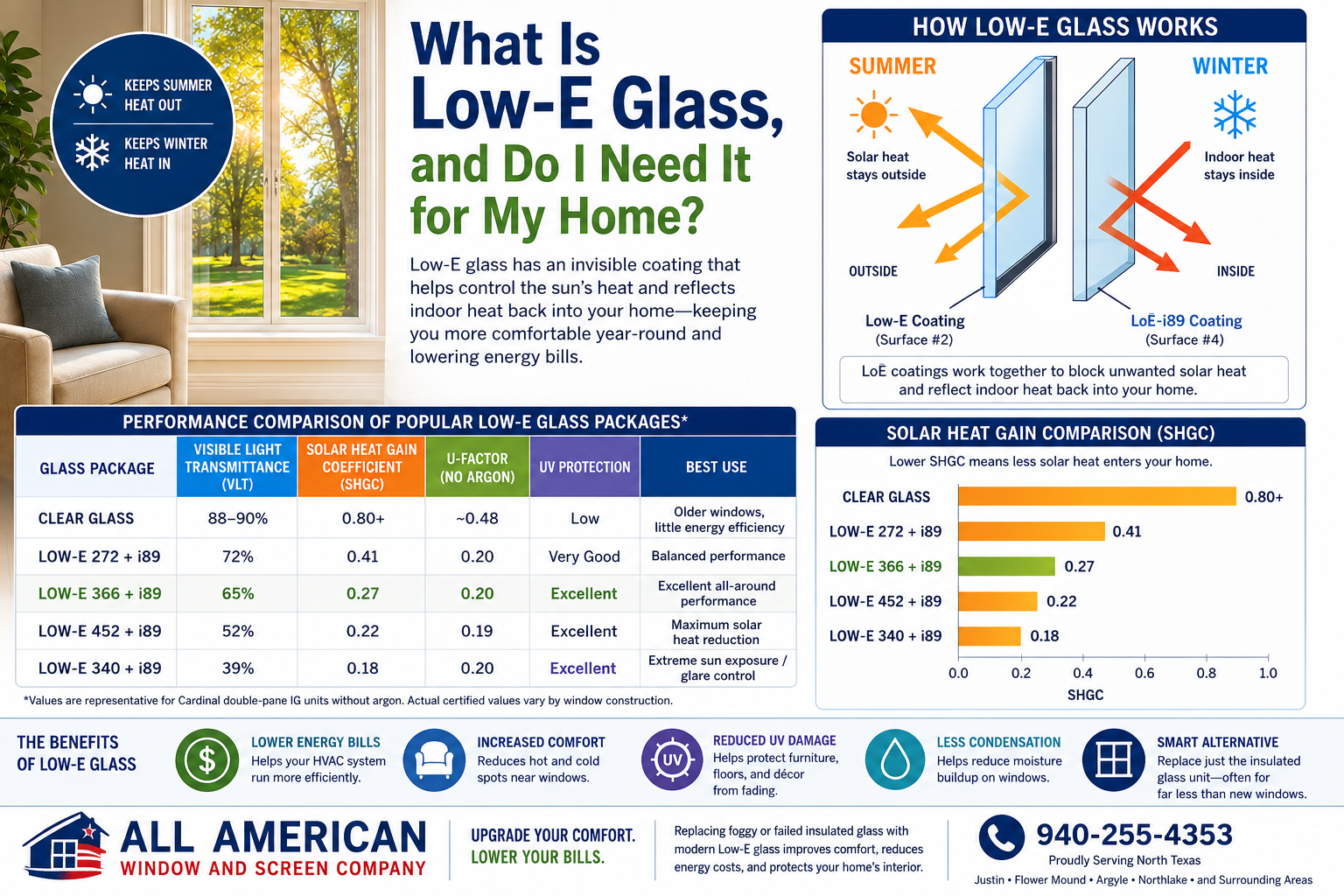
What Is Low-E Glass, and Do You Really Need It for Your Home?
If you've been researching replacement windows or replacing foggy glass, you've probably come across the term Low-E glass.
You may be wondering:
"What is Low-E glass, and is it really worth it?"
The short answer is yes. For most homeowners, Low-E glass is one of the best upgrades you can make to improve comfort, lower energy costs, and protect your home's interior.
Let's take a closer look at what it is and why it matters.
What Is Low-E Glass?
Low-E stands for Low Emissivity.
That may sound technical, but the concept is actually very simple.
Low-E glass has an extremely thin, transparent metallic coating that helps control the movement of heat through the glass.
Think of it as sunscreen for your windows.
It allows plenty of natural daylight into your home while helping keep unwanted heat outside during the summer and reducing heat transfer year-round.
Unlike tinted glass, modern Low-E coatings remain nearly invisible while dramatically improving the performance of your windows.
How Does Low-E Glass Work?
Heat from the sun reaches your home as infrared radiation.
Standard clear glass allows much of that heat to pass directly into your home.
Low-E coatings reflect much of that radiant heat before it enters your living space.
During the Summer
The coating reflects much of the sun's heat away from your home.
Benefits include:
Cooler rooms
Reduced hot spots near windows
Less work for your air conditioner
Lower cooling costs
During Cooler Weather
Low-E coatings also help reduce heat transfer through the glass, improving comfort and helping maintain more consistent indoor temperatures.
What Is LoĒ-i89®?
Many homeowners notice glass packages labeled:
Low-E 272 + i89
Low-E 366 + i89
Low-E 452 + i89
The i89 coating works alongside the primary Low-E coating.
While the primary Low-E coating is designed to reduce the sun's heat entering your home, LoĒ-i89 helps reflect your home's conditioned air back into the room, improving the insulating performance of the insulated glass unit.
Together they provide year-round comfort and greater energy efficiency.
Does Low-E Glass Block Sunlight?
No.
This is one of the biggest misconceptions.
Low-E coatings are designed to reduce heat, not daylight.
Your home still feels bright and open while allowing much less unwanted solar heat to enter.
Benefits of Low-E Glass
Lower Energy Bills
Reducing heat transfer means your heating and cooling system doesn't have to work as hard.
Improved Comfort
Rooms stay more comfortable throughout the day with fewer hot or cold spots near windows.
Reduced UV Damage
Low-E glass helps block much of the ultraviolet light that causes:
Hardwood floors to fade
Furniture discoloration
Carpet fading
Curtain damage
Artwork deterioration
Less Interior Condensation
Modern insulated Low-E glass can also reduce moisture buildup on interior glass surfaces during certain weather conditions.
Which Low-E Glass Is Right for Your Home?
Low-E 272 + i89
A balanced option that provides:
Plenty of natural daylight
Good heat reduction
Excellent everyday performance
Ideal for homeowners who want a bright home while improving energy efficiency.
Low-E 366 + i89
This is our most recommended glass package for North Texas homeowners.
It provides:
Excellent natural light
Outstanding solar heat control
Strong UV protection
Excellent year-round comfort
For most homes, Low-E 366 offers the best balance of performance and appearance.
Low-E 452 + i89
Perfect for homes with:
Large west-facing windows
Significant afternoon sun
High cooling costs
It blocks even more solar heat than Low-E 366 while still allowing comfortable natural light into the home.
Low-E 340 + i89
Designed for situations where maximum solar control is desired.
Best suited for:
Homes with extensive glass
Rooms with severe glare
Areas receiving intense direct sunlight
It offers exceptional heat rejection while noticeably reducing brightness.
Do You Need New Windows?
Not necessarily.
If your window frames are still in good condition but your insulated glass has become:
Foggy
Broken
Cracked
Failed
you may only need to replace the insulated glass instead of the entire window.
This can provide modern Low-E performance while saving thousands of dollars compared to full window replacement.
Which Glass Do We Recommend?
Your SituationRecommended GlassMost North Texas homes⭐ Low-E 366 + i89Large west-facing windows⭐ Low-E 452 + i89Heavy afternoon sun⭐ Low-E 452 + i89Maximum daylight⭐ Low-E 272 + i89Maximum glare reduction⭐ Low-E 340 + i89
The Bottom Line
Low-E glass is one of the smartest upgrades you can make for your home.
It helps reduce unwanted solar heat, improves indoor comfort, protects your furniture and flooring from UV damage, and can lower heating and cooling costs.
If your insulated glass has become foggy or broken, replacing just the glass with a modern Low-E insulated glass unit can often provide the performance of today's energy-efficient windows without the expense of replacing the entire window.
At All American Window and Screen Company, we help homeowners throughout North Texas choose the right Low-E glass package for their home and budget. Whether you're replacing foggy glass, repairing broken double-pane windows, or upgrading older glass for better comfort and efficiency, we're here to help you make an informed decision.
If you'd like to learn which Low-E glass is best for your home, contact us today for a free consultation
Call or text 940-255-4353
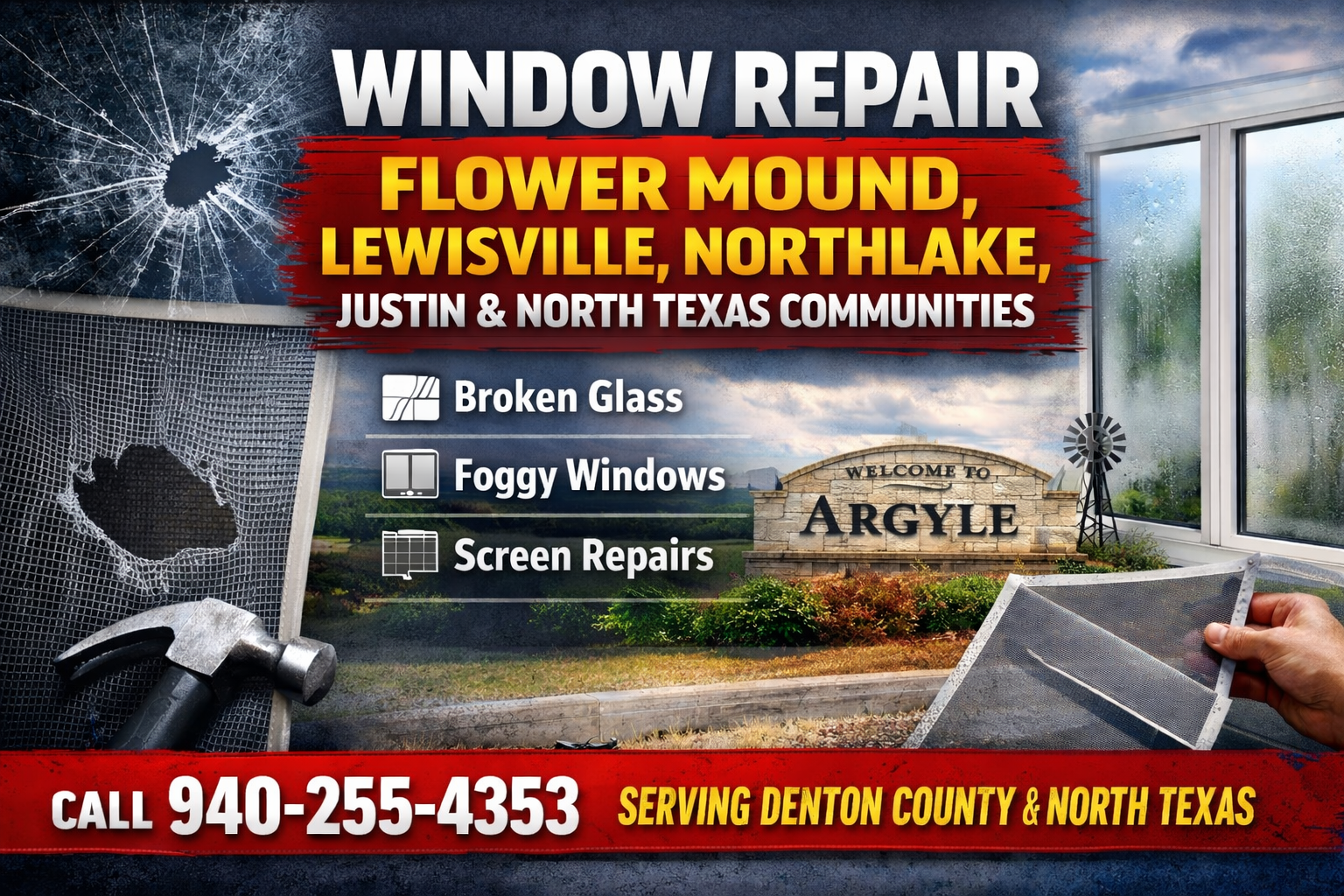
How much will it cost to repair a window?
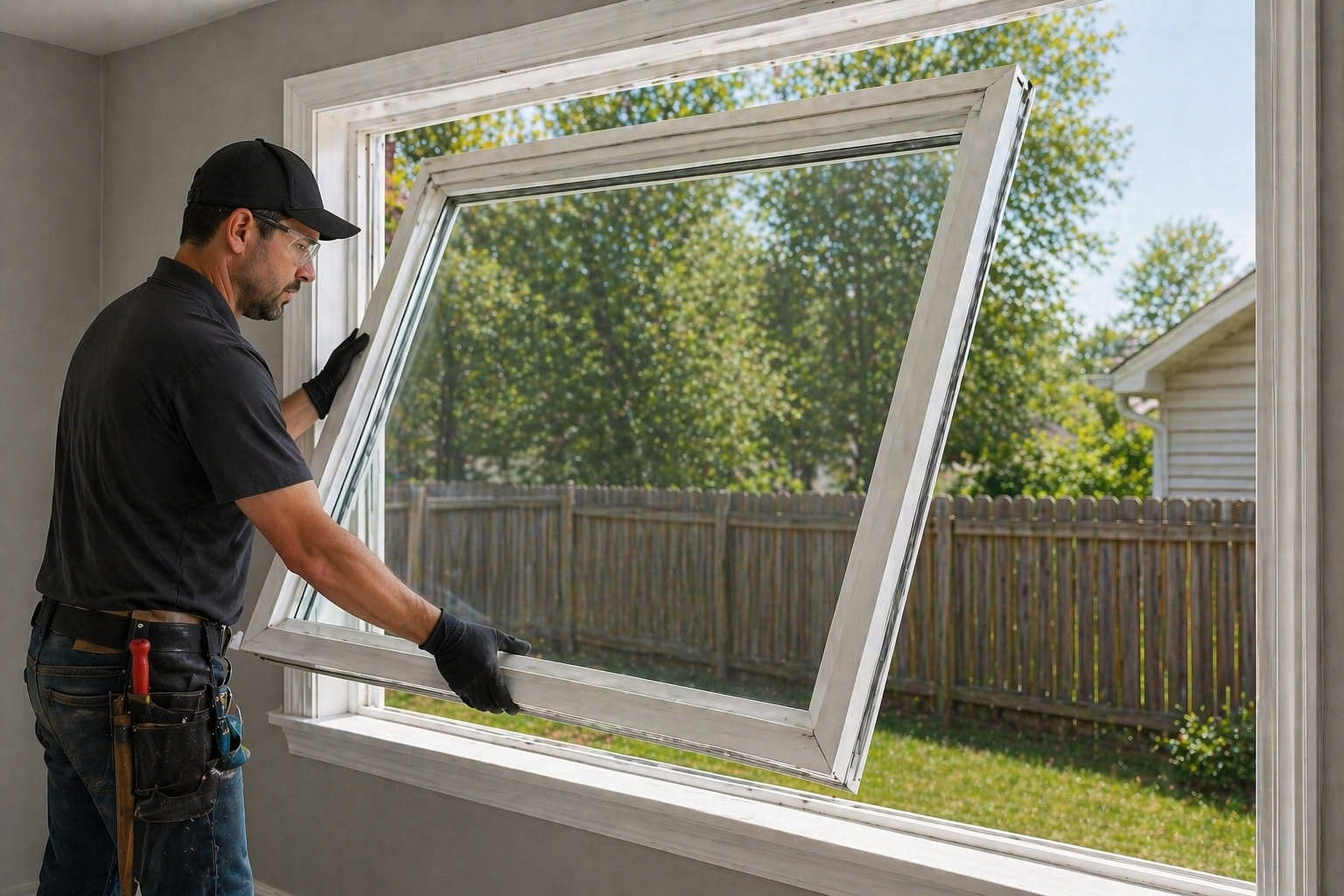
How Much Does Window Repair Cost?
The cost to repair a window depends on what part of the window is damaged. In many cases, the window frame itself is still in good condition and only the glass or hardware needs to be repaired.
Here are the most common window repair services and typical price ranges. These prices are subject to final inspection of the window that needs to be repaired.
Foggy Double-Pane Window Glass (Failed Seal)
When moisture gets trapped between the panes, the insulated glass unit has failed.
Typical cost depending on size of the window: $200 – $600 depending on size and glass type.
The good news is the entire window usually does not need to be replaced. The glass unit can often be replaced while keeping the existing frame.
Broken Window Glass
If a pane of glass is cracked or shattered, the glass can usually be replaced without replacing the whole window.
Typical cost depending on size of window: $200-$600 depending on size and glass type
Window Screen Replacement
Screens can tear over time or get damaged from weather, pets, or hail.
Typical cost: $35 – $75 per screen depending on size and mesh type
Window Hardware Repairs
Issues like broken operators, locks, or balances can prevent windows from opening or closing properly.
Typical cost: $100 – $350 depending on the part needed
When a Window Might Need Replacement
If the frame is severely damaged, warped, or rotting, replacement may be the better option. However, many window issues can be repaired at a fraction of the cost of full window replacement.
Prices are subject to a final evaluation of the window repair. To get a more accurate quote, contact us to schedule a free estimate.
940-255-4353 Call or Text
Get a Free Estimate
If you're not sure what type of repair your window needs, we can help. A quick photo of the window often allows us to provide a fast estimate.
Call or text 940-255-4353 to get a quote.
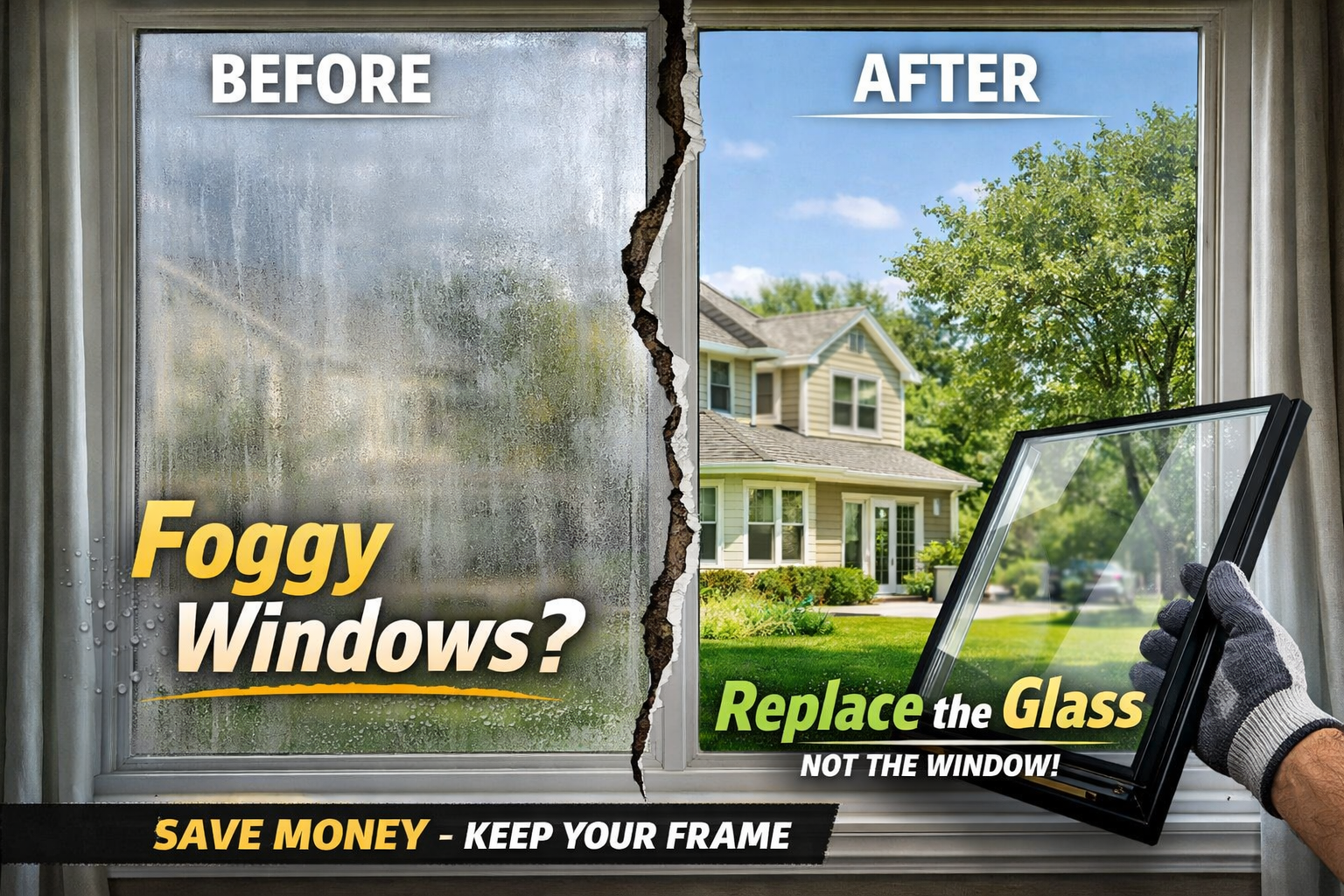
Can Foggy Windows Be Repaired Without Replacing the Entire Window?
Foggy windows don’t always mean you need new windows. Learn how replacing the glass can restore clarity and save homeowners hundreds or even thousands of dollars.
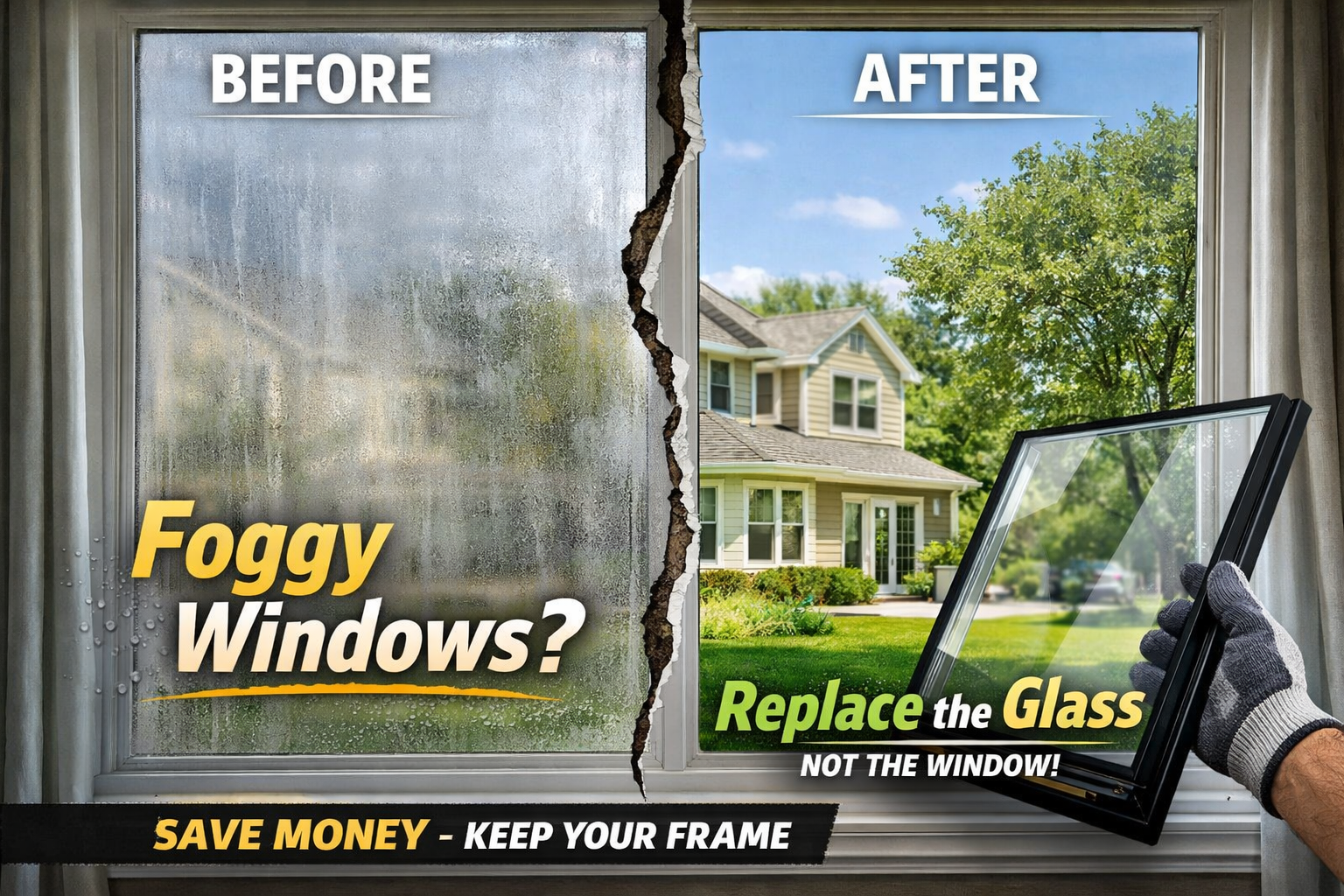
If you’ve noticed cloudy or foggy glass inside your windows, you’re not alone. Many homeowners assume the entire window needs to be replaced when this happens. The good news is that in many cases foggy windows can be repaired by replacing the glass only, not the entire window.
For homeowners across Justin, Argyle, Denton, Flower Mound, and surrounding North Texas communities, this can save hundreds or even thousands of dollars compared to full window replacement.
Why Do Windows Become Foggy?
Most modern homes use double-pane windows, also called insulated glass units (IGUs). These windows contain:
Two panes of glass
A sealed spacer between the panes
Insulating gas or air inside the sealed space
This sealed space helps improve energy efficiency and insulation.
Over time, however, the seal around the glass can fail. When that happens, outside air and moisture enter the space between the panes. This creates the foggy, cloudy appearance many homeowners notice.
Common causes of seal failure include:
Age and natural wear
Heat and sun exposure
Temperature fluctuations
Improper installation
Frame movement over time
Once the seal fails, the moisture trapped between the panes can create condensation, streaking, or mineral buildup inside the glass.
The Good News: You Usually Don’t Need a New Window
Many homeowners are told they need entirely new windows, but that’s often unnecessary.
In most situations, the window frame itself is still perfectly fine. The only component that has failed is the insulated glass unit inside the frame.
Instead of replacing the entire window, a professional can:
Remove the damaged insulated glass unit
Install a new sealed double-pane glass unit
Restore the window’s clarity and insulation
This process is known as glass replacement or insulated glass unit replacement.
The result is a window that looks and performs like new—without the cost of replacing the entire window frame.
Repair vs Window Replacement: What’s the Difference?
Here’s a simple comparison:
OptionWhat Gets ReplacedTypical Cost ImpactGlass ReplacementOnly the double-pane glass unitMuch lower costFull Window ReplacementFrame, sash, glass, trimMuch higher cost
Full window replacement is usually only necessary if:
The window frame is damaged
The frame is rotting or warped
The window design is outdated or failing structurally
If the frame is still in good condition, replacing the glass is usually the most practical and cost-effective solution.
Signs Your Window Seal Has Failed
Homeowners often notice several symptoms when the seal between panes fails:
Fog or haze between the glass panes
Condensation trapped inside the window
Mineral deposits or streaks inside the glass
Distorted or cloudy appearance
Cleaning the inside or outside of the glass will not fix this problem, because the moisture is trapped between the panes.
Replacing the insulated glass unit is the only way to restore the window’s clarity.
Benefits of Replacing the Glass Instead of the Window
Replacing the glass instead of the entire window provides several advantages:
Lower cost
Glass replacement is typically much more affordable than full window replacement.
Faster installation
Most glass replacements can be completed quickly once the new glass unit arrives.
Keeps the existing frame
If your window frames are in good condition, there’s no need to remove them.
Restores visibility and insulation
A new sealed glass unit restores the window’s clarity and energy efficiency.
Foggy Window Repair in North Texas
Homes throughout Justin, Argyle, Denton, Flower Mound, Northlake, Keller, and surrounding North Texas communities often experience window seal failures due to years of heat and temperature fluctuations.
Replacing the insulated glass unit is a practical way to restore your windows without the expense of full replacement.
If your windows have become cloudy or foggy, replacing the glass may be the solution.
Need Help With Foggy Windows?
If you’re dealing with condensation or cloudy glass between window panes, the issue is often a failed window seal.
In many cases, replacing the insulated glass unit can restore your window’s appearance while avoiding the cost of full window replacement.
All American Window and Screen Company provides foggy window glass replacement and window repair services throughout Denton County and surrounding North Texas communities.
Foggy Windows? Replace the Glass — Not the Window
Call or Text 940-255-4353 for more information about foggy window repair and glass replacement.
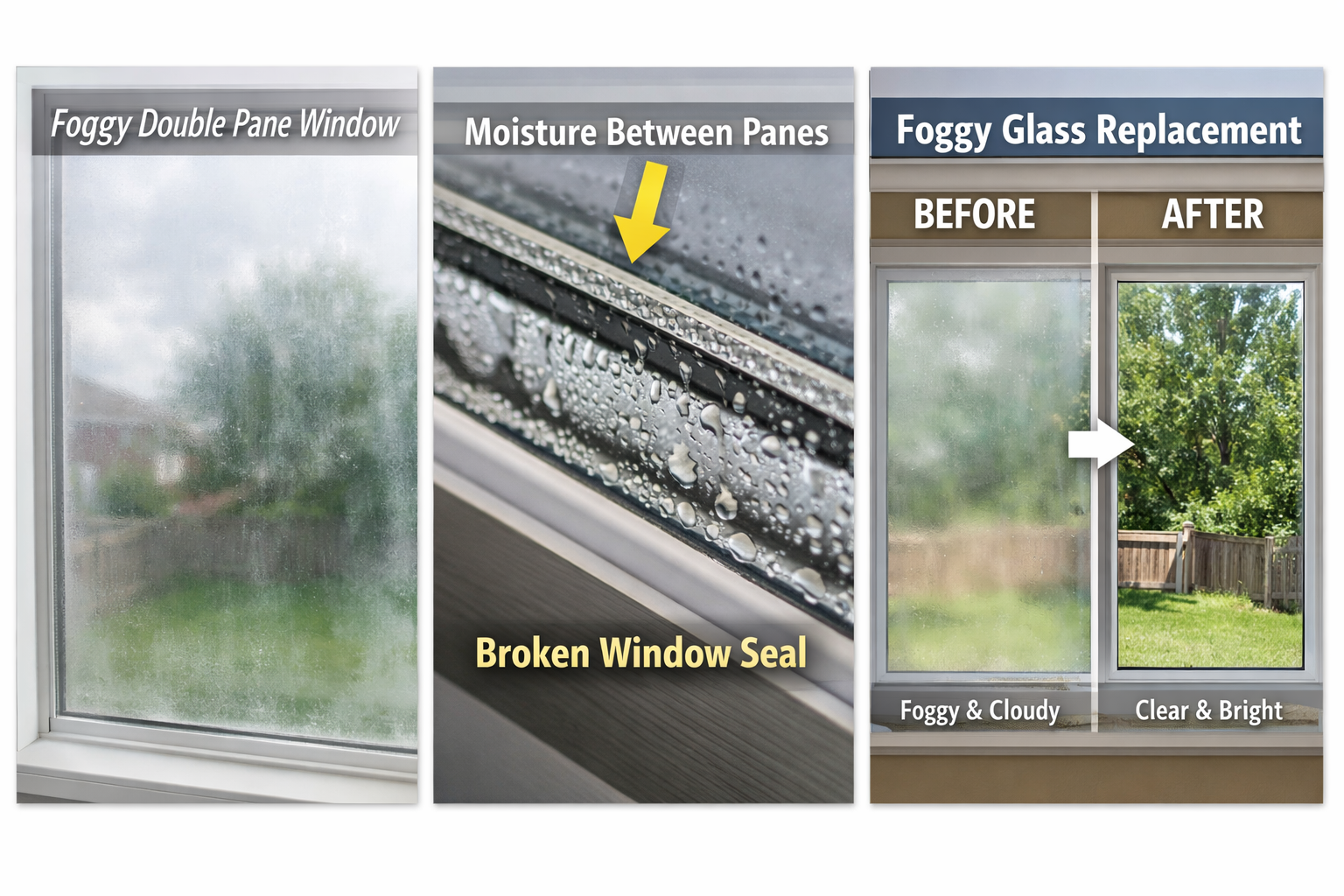
Why Do Double Pane Windows Fog Up?
Foggy windows are a common problem in homes with double pane glass. Learn why window seals fail, what causes moisture between panes, and how foggy window glass can often be repaired without replacing the entire window.
If you’ve noticed your windows looking cloudy or foggy between the panes of glass, you’re not alone. Foggy windows are a common problem in homes across North Texas, especially as windows age. The good news is that in many cases, the problem can be fixed without replacing the entire window.
Understanding why double pane windows fog up can help homeowners make the right repair decision and avoid unnecessary window replacement costs.
How Double Pane Windows Work
Most modern homes use double pane windows, also called insulated glass units (IGUs). These windows are designed with two panes of glass separated by a sealed space between them.
This sealed space typically contains insulating gas such as argon, which helps improve energy efficiency and reduce heat transfer. Around the perimeter of the glass unit is a specialized seal that keeps moisture out and insulating gas inside.
When this seal is intact, the window remains clear and energy efficient.
What Causes Windows to Fog Between the Panes?
Fogging occurs when the seal around the insulated glass unit fails.
Once the seal breaks, outside air and moisture are able to enter the space between the two panes of glass. As temperatures change throughout the day, condensation forms inside the window.
Because the moisture is trapped between the panes, it cannot be wiped away from either side of the glass.
Over time this leads to the cloudy or foggy appearance many homeowners notice.
Common Causes of Window Seal Failure
Several factors can cause window seals to fail, especially in regions like North Texas where homes experience large temperature swings.
Age of the Window
Most double pane windows last between 15 and 25 years. As materials age, the seals naturally weaken and eventually fail.
Heat and Sun Exposure
Texas heat can cause window frames and glass to expand and contract repeatedly, putting stress on the seals.
Installation Issues
Improper installation can cause windows to shift slightly in the frame, leading to premature seal failure.
Manufacturing Defects
In some cases the seal may simply fail earlier than expected due to defects in the original window unit.
Can Foggy Windows Be Repaired?
Many homeowners assume that when a window fogs up, the entire window must be replaced.
In reality, the frame and structure of the window are often still in good condition.
In most cases, the insulated glass unit can be replaced without replacing the entire window frame. This process restores the clarity of the window while keeping the original frame intact.
Replacing the glass instead of the entire window is often much more cost-effective.
Signs Your Window Seal Has Failed
Some common signs of a failed window seal include:
Cloudy or foggy appearance between the glass panes
Water droplets trapped inside the window
A hazy look that cannot be cleaned from the inside or outside
Reduced clarity when looking through the window
If you notice these symptoms, the insulated glass unit may need to be replaced.
Foggy Window Repair in and around Fort Worth
Homes throughout the Fort Worth area, including Justin, Argyle, Flower Mound, Grapevine, and surrounding North Texas communities, frequently experience window seal failure due to heat and age.
If your windows have become cloudy or foggy between the panes, replacing the insulated glass unit can often restore the window to like-new condition without the cost of full window replacement.
Final Thoughts
Foggy windows are usually the result of a failed seal inside a double pane window. While the problem may look serious, it does not always require replacing the entire window.
In many cases, replacing the insulated glass unit is an effective and affordable solution that restores the appearance and function of the window.
Understanding the cause of foggy windows helps homeowners make informed decisions and avoid unnecessary expenses.
If you would like to speak to us about repairing your windows, feel free to reach out to us.
Frequently Asked Questions About Foggy Windows
Can foggy windows be repaired without replacing the entire window?
Yes. In many cases, the insulated glass unit can be replaced while keeping the original window frame. This restores the clarity of the window without the cost of full window replacement.
What causes moisture between double pane windows?
Moisture appears between panes when the seal around the insulated glass unit fails. Once the seal breaks, outside air and humidity can enter the space between the glass.
Are foggy windows a sign of window failure?
Foggy windows usually indicate that the seal between the panes has failed. While the glass unit may need replacement, the window frame is often still in good condition.
How long do double pane windows typically last?
Most double pane windows last between 15 and 25 years before seal failure becomes common. Extreme weather, heat, and sun exposure can shorten that lifespan.
Is it cheaper to repair foggy windows or replace the entire window?
Replacing the insulated glass unit is usually much more affordable than replacing the entire window. Full window replacement is typically only necessary if the frame is damaged.
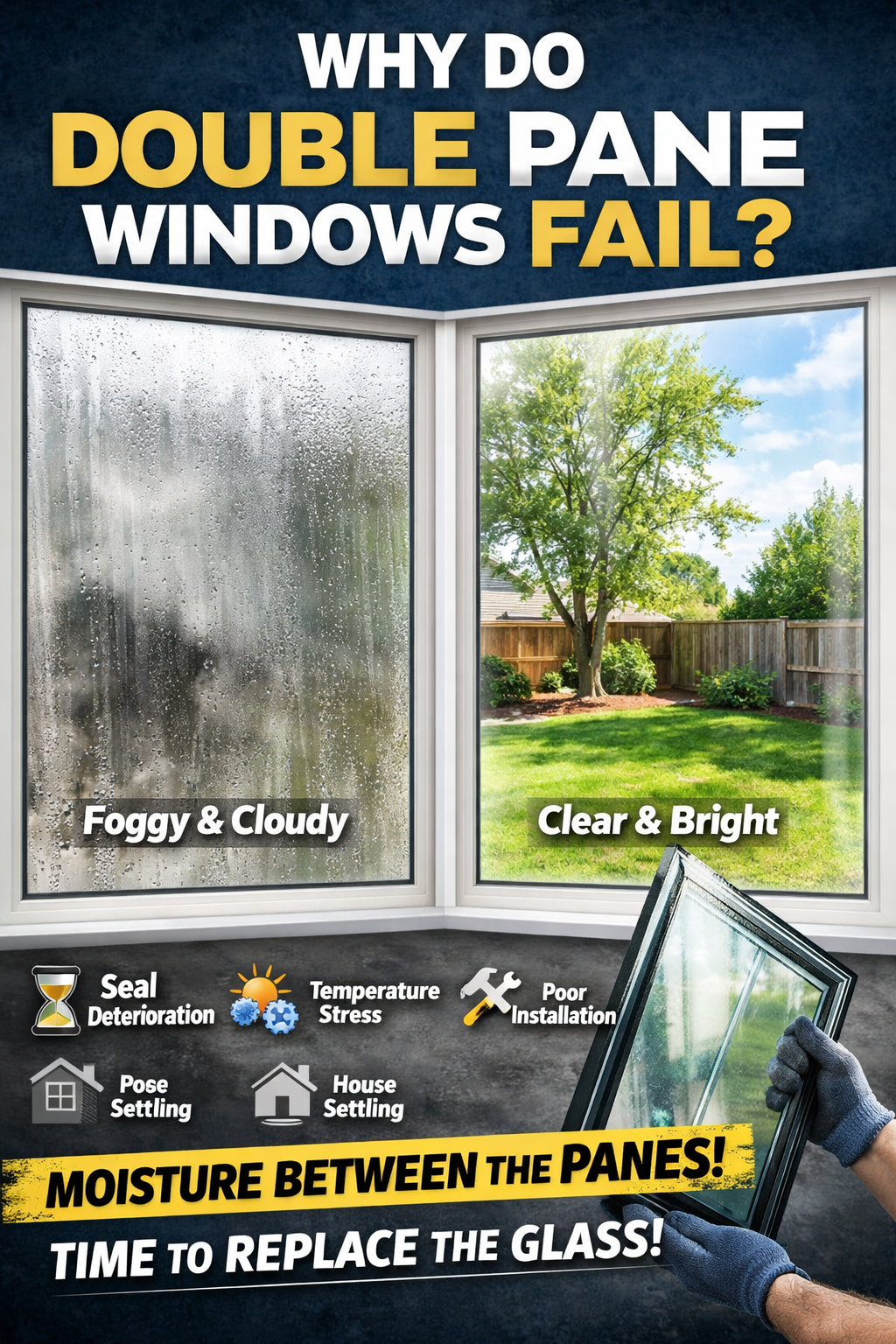
What Causes Double Pane Windows to Fail?
Noticing fog or moisture trapped between your window panes? That’s usually a sign your double pane window seal has failed. Learn what causes double pane windows to fail and why replacing the insulated glass is often the simplest solution.
Double pane windows are designed to improve energy efficiency and comfort by using two layers of glass separated by a sealed airspace. That space is usually filled with insulating gas such as argon. When the seal between the panes fails, moisture enters the space and the window becomes foggy, cloudy, or develops visible condensation between the glass panes.
Seal failure is one of the most common window problems homeowners experience—especially in homes that are 10–20 years old. Below are the most common reasons double pane windows fail.
1. Age and Seal Breakdown
The most common reason double pane windows fail is simply age.
The perimeter seal that holds the two panes together is made from materials designed to expand and contract with temperature changes. Over time, these seals slowly deteriorate.
As the seal weakens:
Outside air begins to enter the insulated glass unit (IGU)
The insulating gas escapes
Moisture gets trapped between the panes
Once moisture enters, the window begins to develop fogging, haze, or water droplets between the glass.
Most double pane windows begin showing signs of seal failure after 10–20 years, depending on the quality of the window and the climate.
2. Extreme Temperature Changes
Temperature swings can put stress on the seals that hold the glass panes together.
In places like North Texas, windows experience:
Hot summer temperatures
Sudden cold fronts in winter
Daily temperature swings
This constant expansion and contraction can weaken the seal over time. Eventually small gaps form, allowing air and moisture to enter the insulated space.
Windows that receive direct sunlight for long periods each day often fail sooner because they heat up more than shaded windows.
3. Poor Window Installation
Improper installation is another major cause of early window failure.
If a window is installed incorrectly, it may experience:
Frame stress
Improper leveling
Twisting or flexing of the window frame
Even small amounts of frame distortion can place pressure on the insulated glass unit, eventually causing the perimeter seal to fail.
Signs of installation-related failure often appear much earlier than normal aging, sometimes within just a few years.
4. Manufacturing Defects
Although rare, some double pane windows fail because of manufacturing issues.
Possible defects include:
Weak sealant materials
Incomplete sealing during manufacturing
Improper gas filling
Low-quality spacer materials
When manufacturing defects occur, seal failure may happen relatively quickly after installation.
5. Window Frame Movement
Homes naturally shift over time due to:
Foundation movement
Soil expansion and contraction
Structural settling
When the window frame moves or twists slightly, it can place stress on the sealed glass unit. Over time this stress weakens the seal and allows moisture to enter between the panes.
6. High Humidity and Moisture Exposure
Windows exposed to constant moisture are more likely to experience seal failure.
Common causes include:
Sprinklers regularly hitting windows
Poor drainage around windows
High humidity climates
Condensation buildup
Moisture exposure slowly degrades the seal materials around the insulated glass.
Signs Your Double Pane Window Has Failed
Homeowners usually notice seal failure through a few clear signs:
• Foggy or cloudy glass between panes
• Condensation trapped inside the glass
• Water droplets between the panes
• A hazy appearance that cannot be cleaned from inside or outside
If the moisture is inside the glass, cleaning the window will not fix the issue.
Do You Have to Replace the Entire Window?
Fortunately, in many cases you do not need to replace the entire window.
Most foggy windows can be repaired by replacing only the insulated glass unit, which is the sealed glass portion of the window. This restores:
Clear visibility
Energy efficiency
The original look of the window
This option is usually far less expensive than replacing the entire window frame and window unit.
Foggy Window Glass Replacement in North Texas
At All American Window and Screen Company, we specialize in replacing failed double pane window glass without replacing the entire window.
If your windows have become foggy or cloudy between the panes, we can restore them with new insulated glass.
Call or text 940-255-4353 for a free estimate.
Serving homeowners in:
Justin • Argyle • Denton • Flower Mound • Haslet • Ponder • Decatur • Northlake, Fort Worth, Grapevine, and surrounding North Texas communities.

A General Guide On How To Measure A Window Screen For Your Home
How to measure a window screen correctly. A guide covering width, height, and frame thickness (5/16, 3/8, 7/16) to ensure your replacement screen fits perfectly.
If your window screen is torn, bent, or missing, replacing it is one of the easiest ways to keep insects out while still allowing fresh air into your home. The most important part of ordering a replacement screen is getting accurate measurements.
Fortunately, measuring a window screen only takes a few minutes and requires just a tape measure.
Follow this step-by-step guide to measure your screen correctly.
Tools You Will Need
Tape measure
Pen or pencil
Paper to write measurements
Flat surface (optional)
Use a tape measure that shows fractions so you can measure accurately.
Step 1: Remove the Window Screen
If the screen is still installed, carefully remove it from the window.
Most screens have small pull tabs or spring clips that allow the screen to be pushed inward so it can be removed.
Place the screen on a flat surface so it can be measured accurately.
Step 2: Measure the Width
Measure the outside edge of the aluminum frame from left to right.
Important tips:
Measure the frame, not the mesh
Measure outside edge to outside edge
Example:
Width = 24 3/16 inches
Step 3: Measure the Height
Next measure the height of the frame from top to bottom, again measuring outside edge to outside edge.
Example:
Height = 36 1/2 inches
Step 4: Measure the Frame Thickness (Depth)
This is one of the most important measurements that many homeowners miss.
Window screen frames come in several thicknesses, most commonly:
5/16 inch
3/8 inch
7/16 inch
Measure the depth of the aluminum frame from front to back.
Why this matters:
If the frame is too thin, the screen may rattle or move in the wind.
If the frame is too thick, it will not fit into the window screen channel.
Most residential window screens use 5/16" or 3/8" frames, but some windows require 7/16".
Taking this measurement ensures your replacement screen fits securely.
Step 5: Write Your Measurements in Order
Screens are always ordered in this format:
Width × Height
Example:
24 3/16" × 36 1/2" with a 3/8" frame
Try to measure to the nearest 1/16 inch whenever possible.
Step 6: Identify the Frame Color
While measuring, note the color of the frame. Common options include:
White
Bronze
Mill (silver aluminum)
Tan
Matching the frame color keeps your replacement screen looking consistent with your windows.
Step 7: Check the Screen Tabs and Spring Clips
Most screens include small pull tabs and spring clips that allow you to remove the screen easily.
Make note of:
Tab location and spring clip location (top, bottom, or side)
What If the Screen Is Missing?
If the screen is missing, you can measure the inside channel of the window where the screen sits.
Open the window
Measure the inside width of the screen track
Measure the inside height of the screen track
These measurements determine the correct screen size.
Common Window Screen Measurement Mistakes
Avoid these common errors:
Measuring the mesh instead of the frame
Always measure the aluminum frame.
Forgetting to measure frame thickness
Screens must match the window channel depth.
Measuring the window instead of the screen opening
Measure the screen frame or the screen track.
Need New Window Screens?
If you live in North Texas, All American Window and Screen Company provides professional window screen replacement and window repairs.
We serve homeowners in:
Justin
Argyle
Flower Mound
Bartonville
Lantana
Haslet
Keller
Denton
Decatur
If your screens are damaged from weather, hail, pets, or age, we can build custom replacement screens that fit just right!
📞 Call or Text: 940-255-4353
🌐 www.windowandscreen.com
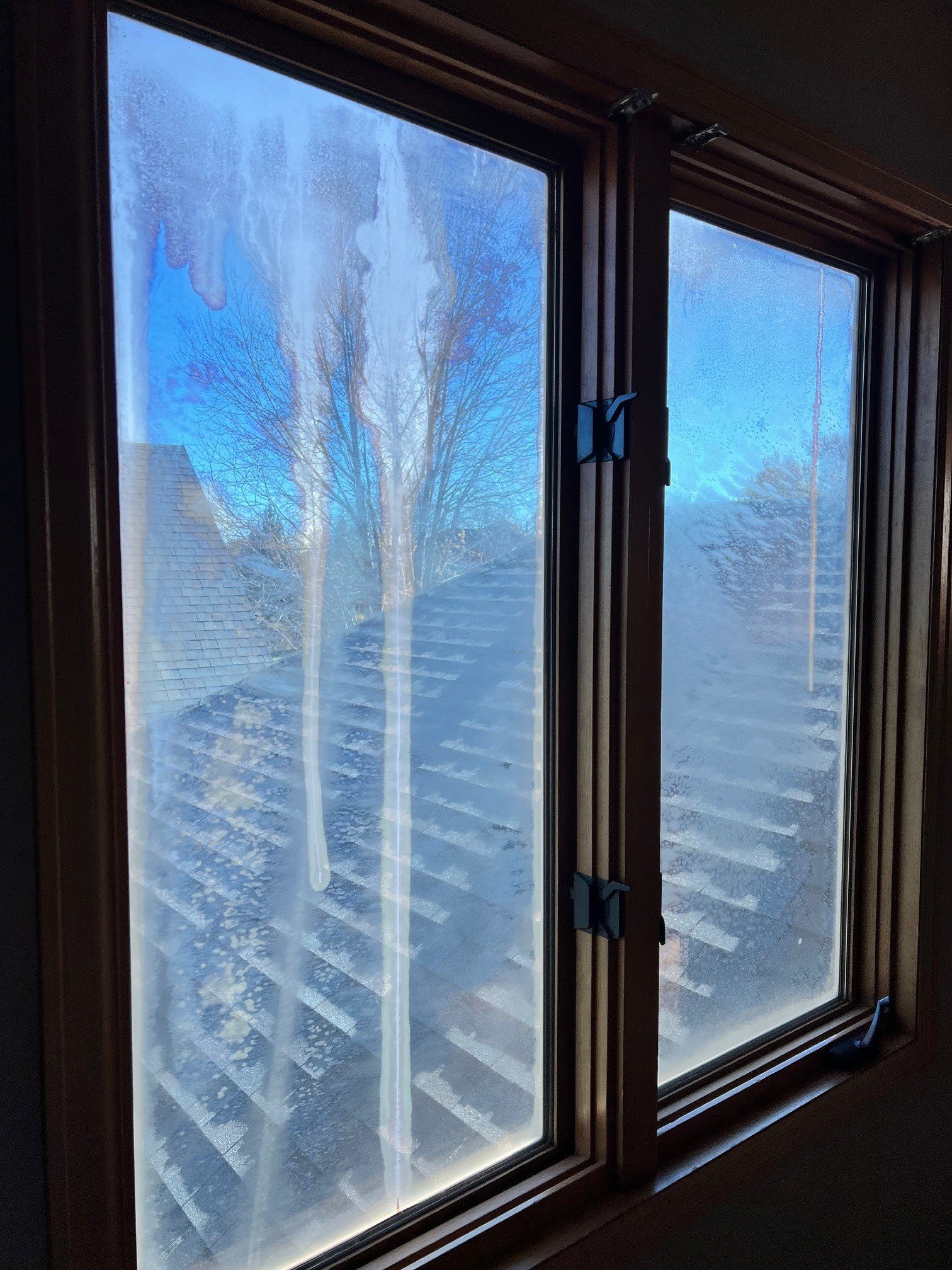
Window Screen Replacement in North Texas
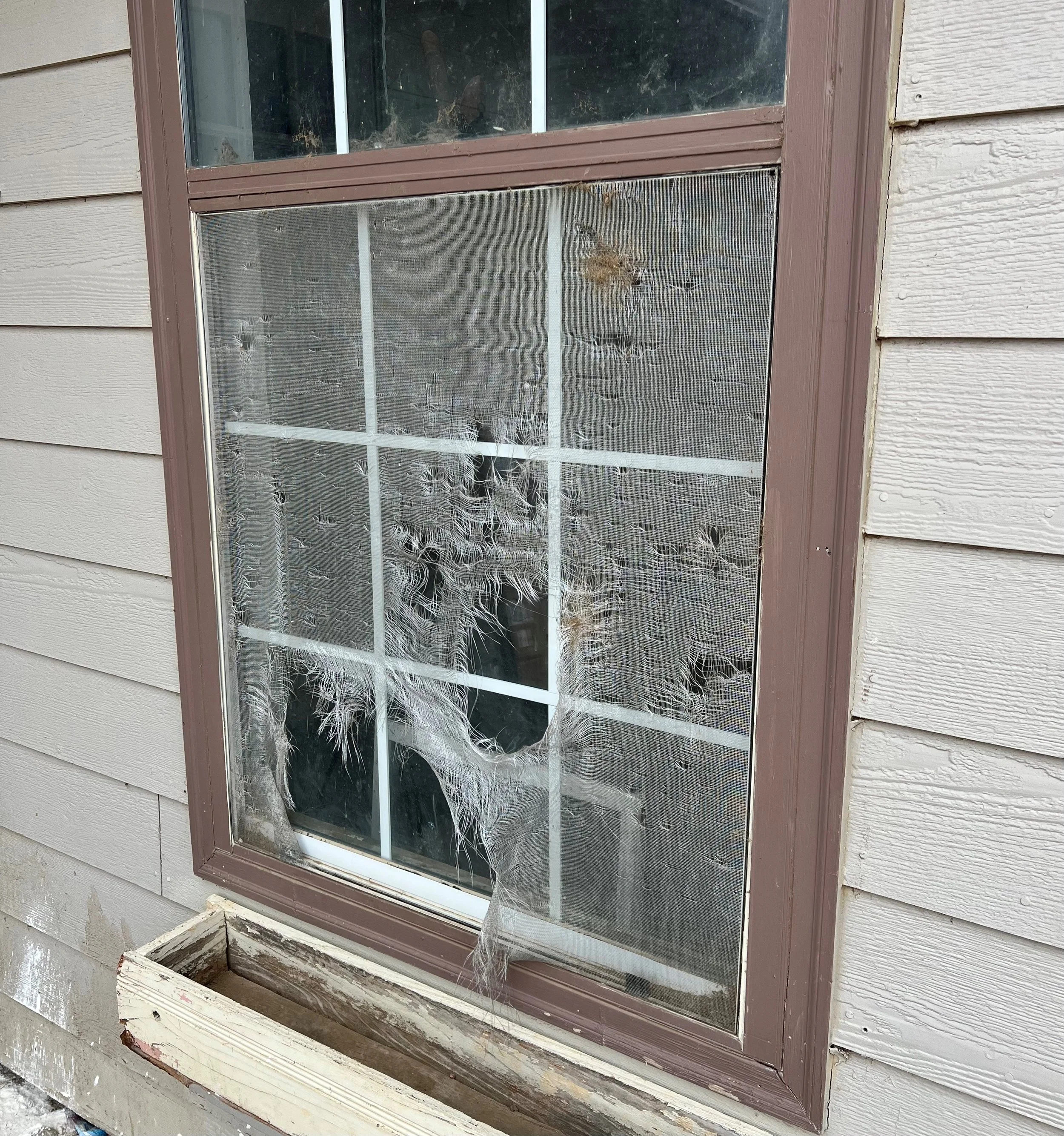
Restore Fresh Air Without the Bugs
If your window screens are torn, bent, or simply worn out from years of Texas weather, replacing them can make a huge difference in the comfort of your home. At All American Window and Screen Company, we specialize in professional window screen replacement for homes across North Texas, helping homeowners enjoy fresh air while keeping insects, debris, and pollen outside where they belong.
Window screens often go unnoticed until they become damaged, but they play an important role in maintaining airflow, comfort, and cleanliness inside your home.
Signs It’s Time to Replace Your Window Screens
Many homeowners wait until screens are completely destroyed before replacing them, but there are several signs that your screens may already need attention:
Torn or ripped screen mesh
Bent or damaged frames
Screens that no longer fit tightly in the window
Rusting or deteriorating corners
Mesh that has become brittle from sun exposure
North Texas weather can be tough on screens. Strong winds, hail, and intense sunlight can cause the mesh and frames to deteriorate over time.
Replacing worn screens can immediately improve how your windows look and function.
Benefits of Replacing Your Window Screens
Replacing damaged screens is one of the easiest ways to improve your home's comfort.
Better Airflow
Fresh screens allow you to open your windows and enjoy cool breezes without worrying about insects getting inside.
Improved Appearance
Old or bent screens can make even a well-maintained home look neglected. New screens give your windows a clean, refreshed look.
Keep Insects Outside
North Texas has its share of mosquitoes, flies, and other pests. Properly fitted screens help keep them outside where they belong.
Increased Home Comfort
Opening your windows for natural ventilation can reduce reliance on air conditioning during cooler mornings and evenings.
Professional Window Screen Replacement
At All American Window and Screen Company, Our services include:
Replacement of torn or damaged window screens
New screen mesh installation
Repair or replacement of bent frames
Custom sizing for many window types
Whether you need a single screen repaired or several screens replaced, we can help restore your windows so they function properly again.
Serving Homeowners Across North Texas
We proudly provide window screen replacement services throughout North Texas, including:
Flower Mound
Argyle
Bartonville
Northlake
Justin
Haslet
Ponder
Decatur
Denton
If you’re searching for “window screen replacement near me”, our team is ready to help.
Get a Free Estimate for Window Screen Replacement
If your window screens are damaged, worn out, or missing altogether, replacing them is a simple way to improve your home’s comfort and appearance.
Contact All American Window and Screen Company today to schedule a free estimate for window screen replacement.
A quick repair or replacement can have your windows looking great and working properly again.
All American Window and Screen Company
📞 940-255-4353
🌐 www.windowandscreen.com
Serving North Texas homeowners with professional window screen replacement and window repair services.
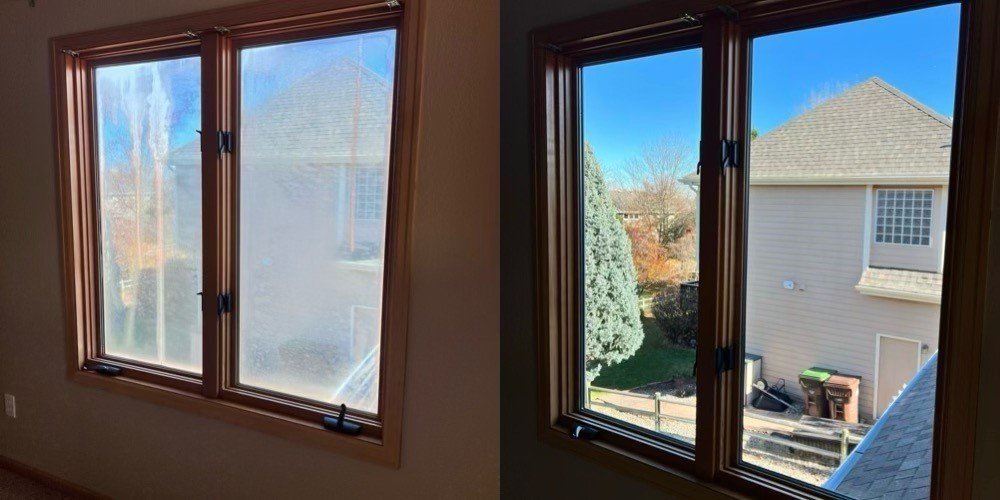
Failed Seals in Double-Pane Windows: What They Are & How Glass Replacement Fixes the Problem
If you’ve noticed fog, condensation, or a cloudy appearance between your window panes, you’re likely dealing with a failed seal in a double-pane window. This is a common issue in North Texas homes, especially as windows age and are exposed to extreme heat, temperature swings, and sun exposure.
The good news? In many cases, the problem can be solved with double-pane window glass replacement, without replacing the entire window frame.
What Is a Failed Seal in a Double-Pane Window?
Double-pane windows (also called insulated glass units or IGUs) are designed with two panes of glass sealed together and filled with insulating gas. When that seal fails, outside air and moisture enter the space between the panes.
This results in:
Foggy or hazy glass
Visible condensation between panes
Reduced energy efficiency
A window that no longer looks clean or clear
Once a seal fails, the glass unit can no longer perform as intended.
What Causes Double-Pane Window Seal Failure?
Seal failure happens over time and is often caused by:
Age and normal wear
Heat expansion and contraction
Prolonged sun exposure
Poor original installation
Structural movement of the home
Storm or impact damage
In North Texas, intense summer heat is one of the most common contributors to seal failure.
Can a Failed Window Seal Be Repaired?
A failed seal cannot be resealed once moisture is trapped between the panes. Temporary defogging methods may improve appearance briefly, but they do not restore insulation or stop future moisture buildup.
The proper solution is to replace the insulated glass unit while keeping the existing window frame—provided the frame is still in good condition.
Double-Pane Window Glass Replacement: How It Works
With glass-only replacement:
The failed insulated glass unit is removed
A new sealed double-pane glass unit is installed
The original window frame remains in place
This approach:
Restores clarity and insulation
Costs less than full window replacement
Preserves the look of your existing windows
Reduces energy loss and heat transfer
For many homeowners, this is the most practical and cost-effective solution.
When Glass Replacement Makes Sense
Glass replacement is often a good option when:
The window frame is structurally sound
Only the glass seal has failed
You want to avoid the cost of full replacement
The home has multiple foggy windows
If the frame is damaged, rotted, or warped, full replacement may be recommended instead.
Signs It’s Time to Address Failed Window Seals
Don’t ignore these warning signs:
Persistent fog or haze that won’t wipe off
Water droplets trapped between panes
Higher energy bills
Uneven indoor temperatures near windows
Addressing seal failure early can help maintain comfort and prevent further issues.
Failed Seal Glass Replacement in North Texas
Homes across North Texas commonly experience double-pane seal failure due to heat and age. Professional evaluation can determine whether glass replacement is a suitable option for your windows and help restore their performance without unnecessary replacement.
Schedule an Evaluation for Foggy or Failed Windows
If your windows are foggy or showing signs of seal failure, a glass replacement evaluation can help you understand your options. Replacing failed double-pane glass units is often the most efficient way to restore clarity, comfort, and energy efficiency.